إظهار الرسائل ذات التسميات St. Olaf. إظهار كافة الرسائل
الاثنين، 27 مايو 2013
In memoriam, Lieut. L. Stanley Finseth, 1920-1943
Born Jan 31, 1920 and raised on the family farm at Kenyon, MN, my uncle Levi Stanley Finseth graduated from Byron H.S. in 1938. He then enrolled at St. Olaf college and later enlisted in the Air Force in 1942. As navigator of a bomber crew he flew 35 missions in North Africa, but died with his crew when their plane was brought down by enemy action over Switzerland on October 1, 1943.
Memorial gifts in his honor were directed to St. Olaf's WCAL, the first listener-supported public radio station. In 1946 when I was born my parents named me after him.
Reposted from 2009 for Memorial Day.
الأربعاء، 19 سبتمبر 2012
Metric American football
...the colleges of Carleton and St. Olaf held the first NCAA-sanctioned metric football game. The “Liter Bowl,” played on September 17, 1977, featured a gridiron measuring 100 meters (109.36 yards) long and 50 meters (54.68 yards) wide. The expanded dimensions favored St. Olaf’s outside running game. The Oles ended up winning the contest—which was supposed to be a game of centimeters—by a score of 43-0.Text from the MN70s tumblr; image from the Carleton College digital archives.
الأربعاء، 13 يونيو 2012
"Um Yah Yah" - the history of the St. Olaf "rouser"
The fight song for St. Olaf College (Northfield, Minnesota) can be heard on several YouTube clips (including at the 2:00 mark here with 15 pianos), but its most curious aspect is in its refrain: "Um! Yah! Yah!, Um! Yah! Yah! Um! Yah! Yah!, Um! Yah! Yah! Um! Yah! Yah!, Um! Yah! Yah! Um! Yah! Yah! Yah!.
There are two stories about the history of those words - a legendary one, and a true one. The legendary background was explained in a 2005 issue of St. Olaf Magazine (via MPR News):
The rouser [is] based upon the old St. Olaf Faculty Hymn, which legend has it was sung at the beginning of all faculty meetings... Hagbarth Hardangerson ’29, who knew many of the great men named in the Faculty Hymn (“They were my teachers”), claimed the faculty never sang anything at their meetings... “most of the faculty couldn’t carry a tune in a bucket, and they never tried singing again.”That hymn supposedly morphed into the modern version:
When you read the refrain(s), which apparently neither the faculty nor anyone else could commit to memory, you will immediately understand why the original words were replaced by the easier-to-remember, albeit somewhat ridiculous, nonsense phrase “um yah yah.”We teach at St. Olaf,
We don’t dance or chew snuff,
Our students are Halvor and Gudrun and Thor;
They study like furious,
Their minds are so curious;
We sure are a bunch of Norwegians galore.
Gulbrandson, Narveson, Huggenvik, Ellingson,
Amundson, Klaragard, Halvorson, Roe.
Fredrickson, Rasmussen, Tollefsrud, Peterson,
Skogerboe, Faillettaz, Jorgenson, Boe.
We teach at St. Olaf,
It’s built on a big bluff,
The wind blows so hard that it causes distress.
But colleagues are glorious
And students uproarious
There’s no place on earth that we’d rather profess.
Christensen, Sheveland, Gustafson, Maakestad,
Lokensgaard, Skurdalsvold, Wrigglesworth, Ross.
Rovelstad, Jacobson, Lutterman, Otterness,
Erickson, Gunderson, Iverson, Foss.
Thormodsgard, Bieberdorf, Overby, Gimmestad,
Kittelsby, Ytterboe, Hinderlie, Njus.
Ditmanson, Odegaard, Hilleboe, Anderson,
Anderson, Anderson, Anderson, Muus!
We come from St. Olaf,That's the legend. Here's the less humorous but more believable true story:
We sure are the real stuff.
Our team is the cream of the colleges great.
We fight fast and furious,
Our team is injurious.
Tonight Carleton College will sure meet its fate.
Um! Yah! Yah!, Um! Yah! Yah!
Um! Yah! Yah! Yah!
A hat tip to Mr. Jeff Sauve, Associate College Archivist at St. Olaf, for providing this information and the image of the original publication; he notes that the basketball Goat Trophy celebrated its centennial this winter too.In 1987, Hagbarth Bue, member of the class of 1911, was interviewed on how the fight song originated (incidentally, the audiocassette is available in the St. Olaf College Archives). Mr. Bue said the 1911 class octet was practicing a Norwegian folk song, "Jeg Har Ute Pulten," which was to be sung at half time of a basketball game. The song was taught to two audiences separated by a basketball court. Because of a shortage of time, they simply substituted Um! Yah! Yah! for the words of the chorus.
The first published account of Um! Yah! Yah! appears in the 1913-14-15 triannual Viking under the song title "Jeg Har Ute Pulten" (embed at right).
الاثنين، 2 أبريل 2012
Physics classroom blackboard
A screencap from the Coen brothers' 2009 film "A Serious Man" (the image has been manipulated for the movie by extending the board vertically). Official trailer.
I have not seen the movie and am not necessarily recommending it, though I have enjoyed their other movies. Posted because the scene above was filmed at St. Olaf College (Northfield, MN), to which my family has longstanding ties.
Via Reddit.
الأحد، 29 يناير 2012
St. Olaf choir
My family ties to St. Olaf College go back to its founding in 1874, so it was a distinct pleasure for me last night to have the opportunity to take my 93-year-old mother to hear the opening concert in this year's centennial tour by the St. Olaf Choir. Mom remembers hearing them on campus in the 1930s, and watches every Christmas concert on PBS.
The choir's performance calendar takes them on to Indianapolis, Charleston, Charlotte, Raleigh, Newport News, Bethesda, Cleveland, Urbana, and Chicago in the next two weeks. The concerts present a mix of ancient and modern music, both sacred and secular/folk. If you like choral music, these are world-class quality performances.
الاثنين، 25 أكتوبر 2010
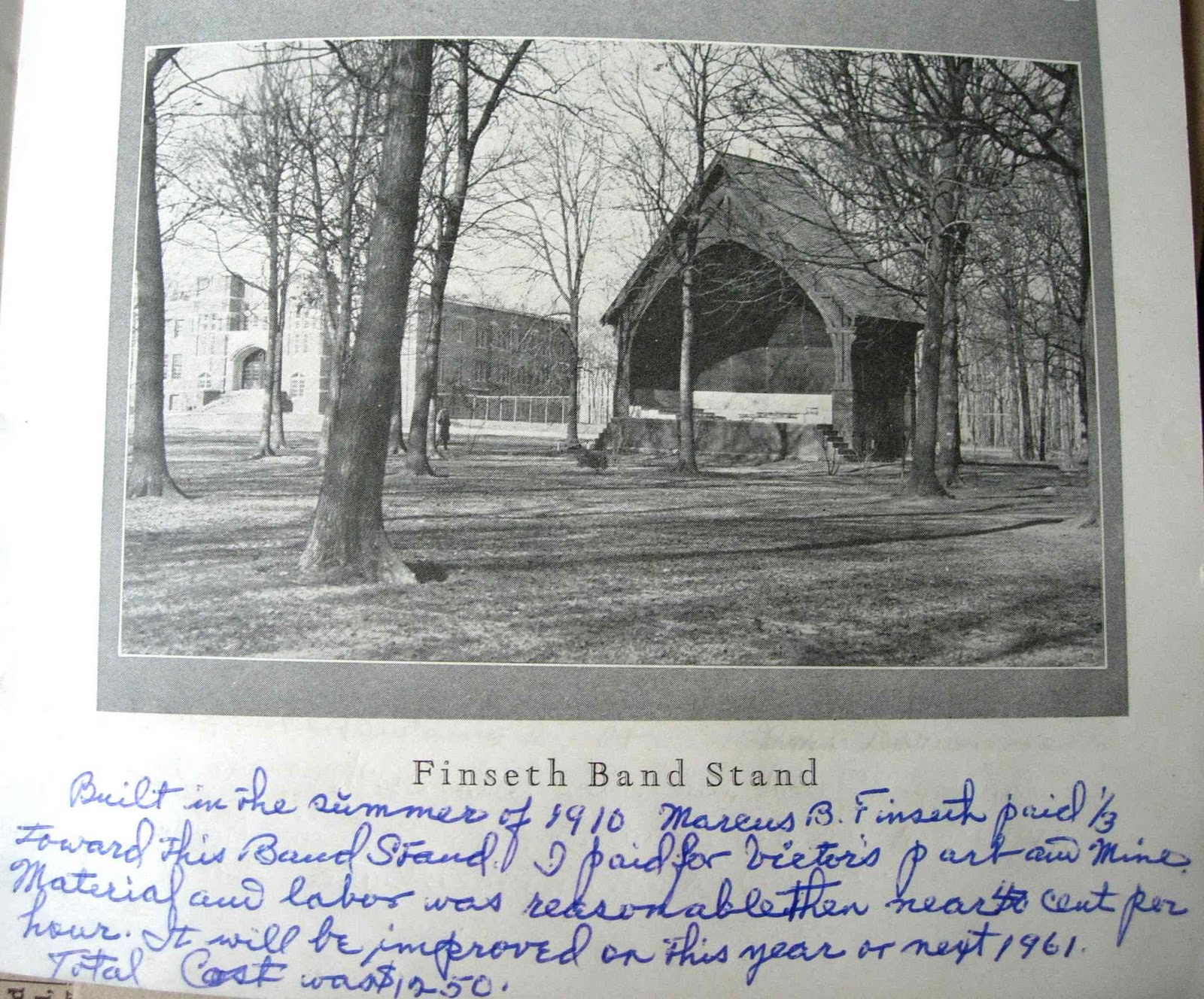
The Finseth Band Stand at St. Olaf College
My family's ties to St. Olaf go back all the way to the school's founding, when my great-grandfather Ole Knut Finseth was one of three farmers who signed of the Articles of Incorporation of the college in 1875. As a youngster I visited with my uncles on many occasions for homecoming football games and marveled at the beautiful campus and the pretty girls who went to school there, but when my own college decision time came, I headed east.
As a result I don't remember ever encountering the Finseth Band Stand, pictured above with a note written by by grandfather Knut Olaus Finseth:
"Built in the summer of 1910 Marcus B. Finseth paid 1/3 toward this Band Stand. I paid for Victor's part and mine. Material and labor was reasonable then near 40 cent per hour. It will be improved on this year or next 1961. Total cost was $1250."Music has always been an integral part of the life of students at St. Olaf. The band stand played its part for several decades:
The Band would play there at appropriate times during the school year, such as the Seventeenth of May. On May 7, 1939 a welcoming ceremony for Crown Prince Olav and his party from Norway took place in Finseth Band Stand. It was used for various concerts in the spring and sumer. Members of St John's Lutheran Church used finseth Band Stand as the place where the congregation held its annual outdoor service and picnic.*When I Googled "Finseth Band Stand" I found only one hit, which linked to some memories of a student of that era:
How romantic the spring open-air band concerts in the Finseth bandstand were. Ida Marvick always sang two songs on such occasions, and we thrilled to her lovely voice. It seems to me that the moon always shone during those concerts. The air was full of springtime and the moonlight made soft patterns on the grass. We girls usually had a boy friend hovering near so that real romance filled our hearts. Lovely evenings they were.
This second photo shows more detail of the band stand, including the fine (Norwegian) woodcraft.
One recalls the Finseth Band Stand as a wooden structure of a dark brown color on the exterior, the interior of the shell painted a lighter color. Its original location was to the west and slightly south of the west wing of the men's dormitory. Its open side faced southeast toward the wooded area between the men's dormitory and the site of the new ladies' dormitory, soon to be built, Mohn Hall. Late in its life, Finseth was moved over to a spot somewhat to the west of Mohn Hall but it disappeared in 1967 when the Mohn Hall area was cleared to provide space for the Science Center.*My understanding from informal and secondhand sources is that in more recent decades the interest in and need for a band stand declined, while some concerts held there became more lively:
A less reverent employment of the stand, hardly in keeping with the piety of the donors, was the series of spring dances announced one year during the 1960s as "Sinfests at Finseth."
Late in its life, Finseth was moved over to a spot somewhat to the west of Mohn Hall but it disappeared in 1967 when the Mohn Hall area was cleared to provide space for the Science Center.*And so it goes.
If there are any Oles out there who can provide additional details or memories, I'd be pleased to read your comments.
*Historical citations provided by Jeff M. Sauve, Assoc. College Archivist at St. Olaf.
الاشتراك في:
الرسائل (Atom)