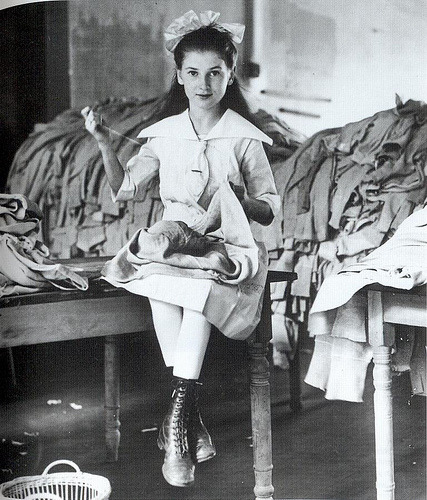
“A young worker mends army uniforms in America. Her sailor suit-style is typical of childrenswear at the time. Boys would have worn a similar top, but with trousers. The bows which girls wore in their hair became known as ‘flappers’ because of the way they fell onto the head. The name would stick with this generation, as they grew up in the Twenties.”Scanned and quoted from the book “Decades of Fashion” by Harriet Worsley. Posted at Beautiful Century, via Edwardian Era.
الثلاثاء، 21 سبتمبر 2010
Origin of the term "flapper"
Purple and orange starfish
Apparently it's real, because after a search I was able to find one other photo of a similar starfish, listed as Daytona Beach 2004. Photo credit for this one to TheMarque.
See also this sea star.
Addendum: A hat tip to Mnkyfuc for identifying this as Astropecten articulatus (described as "very common" at 20-30m depth on the continental shelf off Charleston, S.C.). More pix at the link.
Happy Birthday, Gustav Holst
"Today marks the birthday of British composer Gustav Holst. The Holst family had wandered from Sweden, via Latvia and Russia, to settle in England. Gustav (1874 - 1934) is famous for his symphonic suite, The Planets, extracts of which have been used in many different movies and TV productions. On first rehearsal in the Royal Albert Hall the anecdote has it that the cleaning ladies were dancing in the stalls when they first heard the opening of the Jupiter movement…."Text from Ordinary Finds, where there is always something interesting. Embedded above is the aforementioned Jupiter, the Bringer of Jollity [a hat tip to Ryan for identifying the conductor as Taijiro Iimori leading the Tokyo City Philharmonic Orchestra]. I really love Isao Tomita's performance of The Planets on a Moog synthesizer, which I ought to blog sometime.
If I wait, I'll forget it. Here it his rendition of the Jupiter movement (not a very good video re sound or visuals, but it's all I could find):
How to use "reply all" to get off a spam mailing list
The person who sent the reply makes this point, to emphasize that he wasn't being arbitrarily malicious:
"I got on their spam list by buying a car. I asked several times to be removed from the list, and I was very polite about it. But they ignored me. It was easy enough to filter their mail directly into my junk folder, but on some deep psychological level it bothered me that they ignored my requests to get off of their list.
This is the message that finally made it happen. The message I replied to here was the last message I ever got from them."
Is it correct to say that " 9 NATO troops died" ??
I'm not questioning the incident, which was widely covered in the blogosphere and mainstream news services today. My question focuses on the wording of the title. For the discussion, I'll defer to Michael Quinion at World Wide Words:
Q: Am I right in thinking that “three troops were wounded” not only sounds daft but is incorrect when what is meant is “three soldiers”? “Three troopers”, yes, if they were part of a regiment that is or was mounted.
A: The traditional position that you are likely to find in reference books is that troop is a collective term for a group of people of unspecified number (it’s from medieval Latin troppus, a flock, and is the same word as troupe for a theatrical group). You can refer to more than one troop in the sense of a set of such collections (“the jamboree was attended by several dozen scout troops”) and use troops as a generalised collective term for the forces...
The usage of troops that you refer to is actually not that new. For more than two centuries writers have used it for a countable number of individuals, provided the number is large and not closely specified...
Despite this long history, many people continue to be unhappy about it. The linguist John McWhorter objected to it on National Public Radio in March 2007: “Calling 20,000 soldiers ‘20,000 troops’ depersonalizes the soldiers as individuals...
I’m told that singular troop for an individual has been recorded in US military slang from World War Two. People who were in the services during the 1950s and 1960s confirm it was then common in the US Army (“Yo troop! Take ten troops and police up that latrine!”)...
Troop has developed into a singular and small plural count noun for several reasons. There are now many more women in the various US armed forces and this presents gender-related difficulties in finding suitable terms for individuals (serviceman does not work any longer). More significantly, it’s been difficult to find an inclusive term for a single member of the combined services — soldiers, sailors, airmen, marines and so on... Combatant is almost always pejorative (“enemy combatant”). Not least, troop is usefully short for fitting into headlines...
الاشتراك في:
الرسائل (Atom)