Two photos from the Nikon Small World photomicrography competition for 2013. The top image is of a polished slab of Teepee Canyon agate (credit Doug Moore, UW Stephens Point).
The second one puzzles me. It is a thin section of a dinosaur bone preserved in clear agate (credit Ted Kinsman, Rochester Institute of Technology). I am surprised that the geologic processes that form an agate wouldn't destroy the fine structure of bone matrix. You learn something every day.
إظهار الرسائل ذات التسميات impressive. إظهار كافة الرسائل
الخميس، 14 نوفمبر 2013
الأربعاء، 13 نوفمبر 2013
الجمعة، 8 نوفمبر 2013
Neurons terminating in muscle tissue
A marvelous image to illustrate the term "arborizing."
From the Nikon Small World photomicrography competition for 2013. I love browsing through the galleries each year because of the seemingly endless (but not unenjoyable) hours I spent peering through a microscope during my graduate education and faculty years.
الأربعاء، 6 نوفمبر 2013
Train traversing the Landwasser Viaduct
Designed by Alexander Acatos, it was built between 1901 and 1902 by Müller & Zeerleder for the Rhaetian Railway, which still owns and uses it today. A signature structure of the World Heritage-listed Albula Railway, it is 65 metres (213 ft) high, 136 metres (446 ft) long, and one of its ramps exits straight into the Landwasser Tunnel.Blogged for the beauty of the image, but I'm also impressed by the labor and skill that were involved in its construction.
I suppose it's mandatory to add: "Why a no chicken?"
Photo via, and via Reddit.
الجمعة، 1 نوفمبر 2013
CCC stonework at Robert H. Treman State Park
Today's tour of the Robert H. Treman State Park (Ithaca, N.Y.) features photography by reader Flask Ehrlenmeyer, who was a contributor to the Watkins Glen post last month.
The Friends of the park provide this description of the Civilian Conservation Corps' activities:
"Company 1265, Camp SP-6, Robert H. Treman State Park, Enfield, NY was started up in May of 1933 with tents on platforms. By winter all structures were wooden, Army-style barracks and subsidiary buildings (garage, storage/supply bldg., officers' quarters and HQ bldg., latrine, shower house, infirmary, mess hall, recreation hall, pumphouse...and a covered boxing ring."
"During its first year Camp SP-6, Company 1265 won first place in inspection competition in NY State. It accommodated up to 200 young men, and had sports teams and evening educational programs. Men here did wonderful and still attractive work building bridges and trails in Enfield Glen, Taughannock Falls, and Buttermilk Falls State Parks, and took out flagstones from the creek bed above Taughannock Falls for use in stonework projects in many of the Finger Lakes State Parks of New York State. Some of the men stayed at Enfield Glen (now Robert H. Treman) State Park, while others were taken by truck to the other two parks mentioned above, for the day's work."
"Projects included building stone and timber bridges and retaining walls, constructing scenic foot trails, improving roads in the parks, grading, seeding, and planting trees"
"The Camp was the last to be disestablished in upstate New York, in 1941... The buildings were all sold and removed by the new owners, the land was deeded over to Robert H. Treman State Park, and the site is now an overgrown jungle with a concrete platform here and there under the vegetation, plus the circle of white-painted stones, mostly obscured, that surrounded the flagpole."
For once I'll just hush up and let Flask's photos speak for themselves. There are dozens more photos in the Flickr photoset.
Wow, what a gorgeous park and awesome stonework. For those who like me now have an insane desire to hike the park but live too far away from the Finger Lakes region to make a visit practicable, here is Flask's video tour of the stonework:
Flask is a long-time reader and commenter here at TYWKIWDBI. Her award-winning blog is at Forever, Flask.
الأربعاء، 30 أكتوبر 2013
Optical illusions in a Honda advertisement
Clever use of forced perspective, trompe-l'œil, and other devices in this advertisement apparently filmed in Lake Wobegon.
A programmable automaton from the 18th century
This interesting and less-than-five-minutes video is an excerpt from a full BBC documentary by Professor Simon Schaffer of Cambridge. It features "The Writer," a cam-guided, programmable automaton by Pierre Jacquet-Droz:
The writer is the most complex of the three automata. Using a system similar to the one used for the draughtsman for each letter, he is able to write any custom text up to 40 letters long (the text is rarely changed; one of the latest instances was in honour of president François Mitterrand when he toured the city). The text is coded on a wheel where characters are selected one by one. He uses a goose feather to write, which he inks from time to time, including a shake of the wrist to prevent ink from spilling. His eyes follow the text being written, and the head moves when he takes some ink.The full, hour-long documentary is here. A tip of the blogging hat to reader Alex O. for bringing the link to my attention.
الاثنين، 21 أكتوبر 2013
Sculpting with straw
From Kotaka, which has many more examples assembled in a gallery, via Neatorama.It's fall in Japan. And like every fall, rice is harvested, leaving behind straw to be hung and dried. In some rural areas, though, the rice straw has a special use: Making giant beasts.Kagawa Prefecture and Niigata Prefecture have the most famous "straw art festivals," which are large straw sculpture displays.Traditionally, straw was used to thatch roofs. In much the same manner, these straw sculptures are thatched around wooden frames.
السبت، 5 أكتوبر 2013
"O, wonder! How many goodly creatures are there here!"
Many planthopper species exude waxy secretions from the abdomen, and these sometimes form long strands, such as can be seen in this photo. The long waxy strands may provide protection from predators - it could be that they fool a predator into attacking the wrong part of the insect, and the wax breaks off while the insect jumps to safety.Photo credit Trond Larsen/Conservation International, via a gallery of 20 new species posted in Salon.
الأربعاء، 2 أكتوبر 2013
First prize at Corso Zundert, 2012
Bloemencorso Zundert is the largest flower parade in the world entirely made by volunteers. The parade takes place on the first Sunday of September. The floats are large artworks made of steel wire, cardboard, papier-mâché and flowers. In the Bloemencorso Zundert, only dahlias are used to decorate the objects and it takes thousands of them just to cover one float.There are more photos and videos at the festival's website, including this one -
The huge floats are made by twenty different hamlets and each of them consists of hundreds of builders... A professional and independent jury decides which float is the most beautiful and which hamlet will be crowned the winner of that year.
And I found this impressive one at the Wikipedia entry:
Wow. And unlike many parades in America, these floats don't appear to be sponsored by corporations and designed to sell products.
الثلاثاء، 1 أكتوبر 2013
Antlion larva
الاثنين، 30 سبتمبر 2013
Excellent example of the Ponzo Illusion
The above image was created by 'shopping three identical images of a car onto a photograph of a street. The context of the photo (a receding street) creates in your mind the illusion that the cars are of different sizes - but they are exactly the same. ( I had to measure them to convince myself.)
At Neatorama, Alex Santoso has appended an animated gif to confirm the equality of the car images.
Here's another Ponzo Illusion:
Yes, get out your ruler. We'll wait...
The Leidenfrost Effect is endlessly fascinating
I've written about it before (see "How to dip your hand into liquid nitrogen") and was delighted to find at Nothing to do with Arbroath the above video, in which students at the University of Bath used the effect to create directional movement by droplets of water.
Today I also found a description of the effect from 1868:
Mr. Davenport informs us, that he saw one of the workmen in the King’s Dockyard at Chatham immerse his naked hand in tar of that temperature [220°]. He drew up his coat sleeves, dipped in his hand and wrist, bringing out fluid tar, and pouring it off from his hand as from a ladle. The tar remained in complete contact with his skin, and he wiped it off with tow...And found that the eponym comes from a German physician:
Mr. Davenport ascribes this singular effect to the slowness with which the tar communicates its heat, which he conceives to arise from the abundant volatile vapour which is evolved ‘carrying off rapidly the caloric in a latent state, and intervening between the tar and the skin, so as to prevent the more rapid communication of heat.’..
The workmen informed Mr. Davenport, that, if a person put his hand into the cauldron with his glove on, he would be dreadfully burnt, but this extraordinary result was not put to the test of observation.
"During his lifetime, Leidenfrost published more than seventy manuscripts, including De Aquae Communis Nonnullis Qualitatibus Tractatus (1756) ("A Tract About Some Qualities of Common Water") in which the Leidenfrost effect was first described (although the phenomenon had been previously observed by Herman Boerhaave in 1732)."
الخميس، 26 سبتمبر 2013
Using polio virus to treat brain tumors
This MRI depicts a sagittal view of the head of a 15-year-old boy with GBM.
My wife forwarded to me an article in the Washington Post that is absolutely fascinating.
Glioblastoma multiforme is a particularly vicious type of brain cancer. It arises from neural tissue and is extremely aggressive, infiltrating in a fashion that makes surgical excision virtually impossible, and is resistant to radiation therapy and chemotherapy (because drugs have difficulty penetrating the blood/brain barrier).
Enter the poliovirus, which has evolved over millenia to target neural tissue:
The Preston Robert Tisch Brain Cancer Center at Duke University has the largest experience on the East Coast with my sort of tumor, so I went there for further consultation and treatment.
As doctors there examined me, it was obvious that my tumor had already grown again; in fact, it had quadrupled in size since my initial chemo and radiation. I was offered several treatments and experimental protocols, one of which involved implanting a modified polio virus into my brain. (This had been very successful in treating GBMs in mice.) Duke researchers had been working on this for 10 years and had just received permission from the FDA to treat 10 patients, but for only one a month. (A Duke press release last May explained that the treatment was designed to capitalize “on the discovery that cancer cells have an abundance of receptors that work like magnets in drawing the poliovirus, which then infects and kills the cells. The investigational therapy . . . uses an engineered form of the virus that is lethal to cancer cells, while harmless to normal cells. The therapy is infused directly into a patient’s tumor. The virus-based therapy also triggers the body’s immune system to attack the infected tumor cells.”)...
I returned to Duke a month after the infusion, and though an MRI showed some expected swelling, the more significant fact was that the tumor had stopped growing. I have gone back to Duke every two months since then, and the tumor, initially the size of a grape, is now a scar, the size of a small pea. It’s been two years since the initial biopsy and radiation, and one year since the experimental polio viral treatment, and I have no evidence of recurrence nor tumor regrowth.
الثلاثاء، 24 سبتمبر 2013
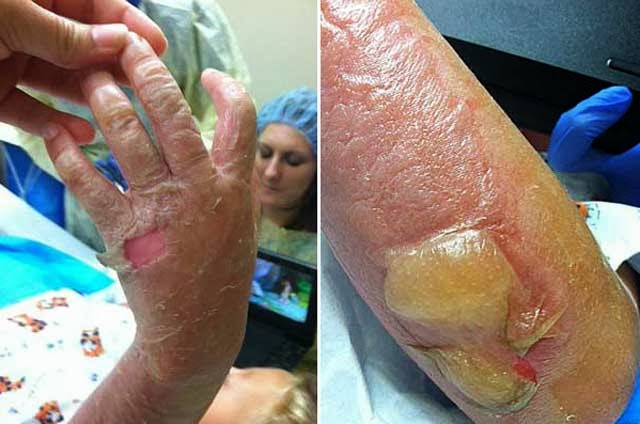
Phytophotodermatitis
It's exactly what the word says - skin (derma) inflammation (itis) caused by exposure to plants (phyto) and sunlight (photo). My wife has experienced it after brusing against rue in our garden (which we raise for the Black Swallowtails). Other plants capable of photosensitizing human skin are listed in the Wikipedia entry, and include wild parsnip (which we encounter frequently while hiking in our part of the Midwest), parsley, celery, lemon, and lime.
The photos above are from a report on a group of children burned after playing with lime juice.
What at first seemed to be overexposure to the sun blossomed into softball-sized blisters and second-degree burns. Her girls, Jewels, 12, and Jazmyn, 9, wound up spending several days in an intensive care unit, hooked up to morphine to manage the pain...The tricky part is that even after initial clinical resolution, the victim has to minimize exposure to sunlight because the light can cause recrudescence of the lesions even without reexposure to the sensitizer.
A neighbor had a large lime tree that grew over the fence into the backyard where the girls went swimming. They had picked some of the fruits and squeezed them out into imaginary tea cups in their play lemonade stand... She remembered the girls crushing the fruits, juice sliding down their arms, splashing their legs, hitting their faces.
Via Nothing to do with Arbroath.
الخميس، 19 سبتمبر 2013
Surfer catches wave - and vice versa
"I dropped Sean at the top of the reef, and the ocean went flat, like someone had turned off the tap. It takes a big set to light this slab up, and as Sean sat patiently I saw a big lump coming. I started yelling, but he had no reference as to where he was on the reef so he waited and paddled for this first wave of the set. He just missed it, and when I looked back, this deep blue lump just started draining out, almost sucking him under the wave. He took one big duckdive and got under the breaking lip. On a normal wave this is fine but this thing didn't have a back -- the reef drops to 200m out the back of this place so when it breaks it really folds. The wave had just too much power and sucked him back over the falls, it's pretty much a surfer's worst nightmare position, so many people claim this is photoshopped, but it certainly is not!"From The Atlantic. The image was a winning entry in the Red Bull Illume Image Quest photography competition.
السبت، 14 سبتمبر 2013
Incredible camouflage
This moth is Uropyia meticulodina, found in China and Taiwan. Real Monstrosities has another video showing the moth in flight.
Via Neatorama.
الأربعاء، 11 سبتمبر 2013
Ethiopian opal
Apparently from the Wollo province of Ethiopia.
Opal from Ethiopia that hit the market in 1993 from deposits near Mezezo, Shewa Province, has a tendency to craze. But the Wollo Province deposit was hailed as one of the most promising deposits of precious opal for the coming years in the Summer 2010 issue of Gems & Gemology and the Summer 2011 issue of InColor. “Wollo opal should be recognized as a new type because it can absorb or lose water, affecting transparency and play-of-color when wet, but recovering all its qualities when dry,” report researchers. They describe this new Ethiopian opal find as different from the opals of Shewa Province. Laboratory testing of the Wollo opal revealed most specimens were resistant to crazing after repeatedly being immersed in water and dried out over a period of time. Not only are they stable, researchers say, they’re surprisingly tough.Nine views of the specimen in this imgur album. Video of a beautiful cab here. Via Reddit.
A reminder of our place in the cosmos
The video, from the Hayden Planetarium, zooms out from Nepal to about 14 billion light-years away to show the extent of the known Universe, then zooms back in. The zoom is FTL, so it only takes 6 minutes. If you're going to watch, full-screen would be appropriate.
By someone's calculation, if our galaxy, the Milky Way, were brought down in size to the size of the continental United States, our Sun would be the size of a single red blood cell. And Earth perhaps the size of a malarial parasite.
Via Fact Stream.
الاشتراك في:
الرسائل (Atom)