‏إظهار الرسائل ذات التسميات medicine. إظهار كافة الرسائل

الخميس، 21 نوفمبر 2013

Antibiotics and obesity


Correlation does not prove causation.  For the potentital interrelationship between the two maps above, see the article at Mother Jones.
Hicks and her team can't yet explain the connection between obesity and high rates of antibiotic prescription. "There might be reasons that more obese people need antibiotics," she says. "But it also could be that antibiotic use is leading to obesity."

Indeed, a growing body of evidence suggests that antibiotics might be linked to weight gain. A 2012 New York University study found that antibiotic use in the first six months of life was linked with obesity later on. Another 2012 NYU study found that mice given antibiotics gained more weight than their drug-free counterparts. As my colleague Tom Philpott has noted repeatedly, livestock operations routinely dose animals with low levels of antibiotics to promote growth.
As always, more at the link.

الأربعاء، 20 نوفمبر 2013

Here's why the Obamacare website sucks


An article at TechDirt offers what seems to me the best explanation:
While any massively large-scale internet launch is likely to suffer some problems, the level of disaster on this particular project has been quite impressive...

The Sunlight Foundation figured out the list of contractors who worked on the site, and noted that the big ones not only are well-known DC power-player insiders, but they're also big on the lobbying and political contributions side of things. You've got companies like... Booz Allen Hamilton, famous for promoting cyberwar hype and employing Ed Snowden. There's defense contracting giant Northrup Grumman...

As you look down the list put together by the Sunlight Foundation, it's all companies like this: giant monstrosities which are simply tied in closely with the government. All the large consulting firms are listed: Accenture, Deloitte, PricewaterhouseCoopers, McKinsey. What's missing? Basically any company with even the slightest smidgen of experience building and maintaining large-scale, public-facing web-based apps. The list has no "internet native" companies.  
Incisive commentary from a variety of web-knowledgeable people in the Reddit discussion thread.

الثلاثاء، 19 نوفمبر 2013

Contrasting the Affordable Care Act with Medicare and Social Security

From The Next New Deal ("The blog of the Roosevelt Institute"):
What we often refer to as Category A can be viewed as a “neoliberal” approach to social insurance, heavy on private provisioning and means-testing. This term often obscures more than it helps, but think of it as a plan for reworking the entire logic of government to simply act as an enabler to market activities, with perhaps some coordinated charity to individuals most in need.
social_insurance_categoryThis contrasts with the Category B grouping, which we associate with the New Deal and the Great Society. This approach creates a universal floor so that individuals don’t experience basic welfare goods as commodities to buy and sell themselves. This is a continuum rather than a hard line, of course, but readers will note that Social Security and Medicare are more in Category B category rather than Category A. My man Franklin Delano Roosevelt may not have known about JavaScript and agile programming, but he knew a few things about the public provisioning of social insurance, and he realized the second category, while conceptually more work for the government, can eliminate a lot of unnecessary administrative problems.
Via The Dish (more discussion at both links).  Cartoon from The New Yorker.

الخميس، 14 نوفمبر 2013

Solanine poisoning

[T]he potato is the most common cause of solanine poisoning in humans. But how do you know when solanine is present in a potato? The tuber is turning green.

Though the green color that forms on the skin of a potato is actually chlorophyll, which isn’t toxic at all (it’s the plant’s response to light exposure), the presence of chlorophyll indicates concentrations of solanine. The nerve toxin is produced in the green part of the potato (the leaves, the stem, and any green spots on the skin).

The reason it exists? It’s a part of the plant’s defense against insects, disease and other predators. If you eat enough of the green stuff, it can cause vomiting, diarrhea, headaches, paralysis of the central nervous system... but in some rare cases the poisoning can cause coma—even death...

Fatal cases of solanine poisoning are very rare these days. Most commercial varieties of potatoes are screened for solanine, but any potato will build up the toxin to dangerous levels if exposed to light or stored improperly. Often, the highest concentrations of solanine are in the peel, just below the surface and in the sprouted “eyes”—things that are typically removed in cooking preparation...
More at the Smithsonian's Food & Think blog.  Photo credit unknown.

الأربعاء، 13 نوفمبر 2013

Pertussis re-emerges because of anti-vaccine parents

"The problem, in part, is that the protection offered by the pertussis vaccine wears off by the time you reach adulthood. Until recently, however, this was not a problem. Back in those halcyon days when we vaccinated our children, the disease was not bouncing around our population and so it was okay that adults did not get re-immunized. (That's the whole point of herd immunity: it's hard to get sick from people who aren't sick...

"How responsible are these non-vaccinating parents for my pertussis? Very. A study recently published in the journal Pediatrics indicated that outbreaks of these antediluvian diseases clustered where parents filed non-medical exemptions – that is, where parents decided not to vaccinate their kids because of their personal beliefs. The study found that areas with high concentrations of conscientious objectors were 2.5 times more likely to have an outbreak of pertussis."
Graph credit Jen Kirby, based on data from the CDC.  Via The Dish.

الثلاثاء، 5 نوفمبر 2013

DNA testing reveals fake "herbal supplements"


As reported in the New York Times:
Using a test called DNA barcoding, a kind of genetic fingerprinting that has also been used to help uncover labeling fraud in the commercial seafood industry, Canadian researchers tested 44 bottles of popular supplements sold by 12 companies. They found that many were not what they claimed to be, and that pills labeled as popular herbs were often diluted — or replaced entirely — by cheap fillers like soybean, wheat and rice.
Consumer advocates and scientists say the research provides more evidence that the herbal supplement industry is riddled with questionable practices. Industry representatives argue that any problems are not widespread. 

For the study, the researchers selected popular medicinal herbs, and then randomly bought different brands of those products from stores and outlets in Canada and the United States. To avoid singling out any company, they did not disclose any product names. 

Among their findings were bottles of echinacea supplements, used by millions of Americans to prevent and treat colds, that contained ground up bitter weed, Parthenium hysterophorus, an invasive plant found in India and Australia that has been linked to rashes, nausea and flatulence. 

Two bottles labeled as St. John’s wort, which studies have shown may treat mild depression, contained none of the medicinal herb. Instead, the pills in one bottle were made of nothing but rice, and another bottle contained only Alexandrian senna, an Egyptian yellow shrub that is a powerful laxative. Gingko biloba supplements, promoted as memory enhancers, were mixed with fillers and black walnut, a potentially deadly hazard for people with nut allergies...
Of 44 herbal supplements tested, one-third showed outright substitution, meaning there was no trace of the plant advertised on the bottle — only another plant in its place. 
More at the link.

A comparison of trephination techniques

"This skull shows four different instruments used for trephination. The instruments include a shark’s tooth, a flint-pointed bow drill, a flint scraper and obsidian – a naturally occurring volcanic glass. Each instrument makes a different type and size of hole. This skull was owned by Dr Thomas Wilson Parry (1866-1945), an English doctor who did extensive practical research into Neolithic trephination instruments and techniques."
Text and images from Science Museum (U.K.), via Sutured Infection.

الاثنين، 28 أكتوبر 2013

The rising cost of cancer drugs

"Cost of one month of treatment for an adult for each new cancer drug approved by the United States Food and Drug Administration, based on Medicare reimbursement rates and by year of drug approval."

Graph from Memorial Sloan-Kettering Cancer Center.   The following text is excerpted from an excellent article ("The Cost of Living") in New York magazine:
...the unspoken rule in American health care is that doctors should never consider the cost of a medicine that might be beneficial to patients. When the FDA approves a new cancer drug, it analyzes safety and effectiveness only. Medicare is obliged to reimburse payment for the drug, and private insurers in most states must cover the cost. Any doctor who considers cost—or the value of a costly drug—risks being accused of “rationing” health care...

What is sobering about this booming business is that, as a group of oncologists wrote earlier this year, “most anti-cancer drugs provide minor survival benefits, if at all.” They often (but not always) reduce the size of inoperable tumors, but they rarely eradicate the disease. For relatively uncommon malignancies like testicular cancer, some forms of leukemia, and lymphoma, drugs effectively cure the disease; for the common “solid tumor” cancers (lung, breast, colon, prostate, and so on), which account for the vast majority of annual cases, drugs buy some time—precious time, to be sure, but time usually measured in weeks and months rather than years...

...the average price of cancer drugs has gone “through the roof,” according to George W. Sledge Jr., former president of the American Society of Clinical Oncology. “What predicts the price of the next cancer drug is the price of the last cancer drug,” says Bach. “The only check on the system is corporate chutzpah.”..

A lot of what determines the price of cancer drugs can be attributed to the byzantine economics of health care: markets that don’t behave the way “real world” markets do; artificial price supports that are called something else; government regulations that remove any downward pressures on pricing; and, until Medicare reforms kicked in, in 2005, arcane reimbursement policies that actually rewarded oncologists who used higher-priced drugs, because it would increase the profit margins of their practices.

...the chart documents a recent sea change in pricing. It shows a very slight uptick in prices until the mid-­eighties, when the rise becomes more substantial, and then bends sharply upward around 2000. Beginning about twenty years ago, the graph also shows a series of dots way above the curve of average prices, indicating drugs that, in effect, have broken the sound barrier on price since the nineties.

“Then one day I looked at the whole landscape,” Bach recalled, “and thought, Huh, I now know why cancer-drug prices are so high. Because the entire regulatory environment is structured in a way where there are no downward pressures and there are no standards. Medicare—and most private insurers, who want to do business in most states—have to include every drug in coverage. And they have to pay the producer’s price. It’s kind of that simple.”..

“There is a number in people’s minds,” he says. “If you say to people, ‘I have a drug that extends life by one day at a billion dollars; shouldn’t we as a society pay for it?,’ I’m pretty confident most people would say no. If I say, ‘I have a drug that extends life by three years at a cost of $1.50,’ I’m pretty confident everybody would say, ‘Of course!’ Somewhere in there is a number, a tipping point, where we say, ‘No, we can’t.’ Right now, we’re unwilling as a society to explore where that point is. And I would argue that we have to. Wherever it may be, we have to find it.”  
This is why there will always have to be "death panels."

More at the link - well worth the read.  Via The Incidental Economist and The Dish.

Death by caffeinated candy


As reported in The Independent:
A man died from an enormous caffeine overdose after snacking on high-energy mints - each of which is as powerful as a can of Red Bull...

Mr Jackson was a heavy drinker and had cirrhosis of the liver which would have limited his liver’s ability to process toxins but it was the caffeine overdose that killed him, the pathologist said...

Birkenhead-based Hero Energy said that it highlighted the risk with prominent warnings on packaging and shelves. In a statement, directors Paul Hayes and Steve Hones said they “fully understand” the dangers and risks of caffeine and that the packs advise no more than five be consumed in 24 hours.

The inquest was not told how many Mr Jackson ate but the manufacturers said that he would have had to have eaten “over 300 of our mints, which is staggering” to have the levels of caffeine he had in his blood.
Presumably the estimation of 300-mint consumption was based on normal hepatic metabolism, which would not have been applicable in this case.


Photo via The Mail Online.

الأربعاء، 23 أكتوبر 2013

Why a "pap smear" can cost a thousand dollars

It may not be just a pap smear - it may be a bundled set of tests, as explained in an editorial in the New England Journal of Medicine:
The first time a patient called me to say that she'd been billed more than $600 for her Pap smear, I was sure it was a mistake. The second time, I was less sure, and these days I am no longer surprised to find laboratory charges of $1,000 or more for a test that until recently cost only $20 or $30...

It turns out that the high-ticket screening tests contain multiple items: the Pap test itself, usually in the form of a new liquid-based test rather than the older (and cheaper) slide test; a human papillomavirus (HPV) test, which is recommended only for women 30 to 64 years of age and only once every 5 years; tests for sexually transmitted diseases (recommended routinely only for women 15 to 25 years of age and those with symptoms suggestive of an infection); and sophisticated laboratory tests for a variety of yeasts, the presence or absence of which was once assessed by the physician looking at a slide under a microscope. So how do all these tests come to be ordered for healthy women who come in only for an annual gynecology exam? The answer is that someone, whether the physician or nurse practitioner or the medical assistant processing the specimen, checked off all those boxes on the order form...

Laboratories have learned that one easy way to increase revenue is to make it easy for clinicians to order more tests. In the past year, I have been visited by multiple laboratory representatives touting “improved” tests, virtually all of which involve combination panels that can be easily ordered and that contain extensive lists of fairly esoteric tests. The single-vial women's health test is being heavily marketed by multiple laboratories. It includes not only the Pap and HPV tests but also tests for multiple infections — including some we would rarely have tested for in the past — for which we often have no evidence of benefit. Costly tests that once would have required physicians to submit multiple collection vials and specimens can now be ordered with the Pap smear simply by clicking a single box in the electronic medical record. Nothing at any point along the way alerts either the clinician or the patient to the high costs of these tests or to the fact that there is little medical evidence to suggest that they are useful for most patients. It seems harmless, even possibly beneficial, to run these additional tests, and for our staff, it eliminates the risk of missing a test the doctor might have wanted to have run. The risk it poses, though — the one I face when a patient calls about a crippling bill — is that more and more women may choose not to undergo screening, afraid of the financial consequences.
More at the link.  It's an important concept to understand.

الأربعاء، 2 أكتوبر 2013

The desert strikes back (coccidiomycosis)


Coccidiomycosis ("Valley Fever") used to be a relatively exotic disease, familiar only to a few pulmonary disease specialists.  But now as more Americans move into desert ecosystems to live, more are becoming infected with this fungus, as reported in Vice:
The debilitating affliction has reached epidemic proportions in the Southwest, with infection rates rising at least tenfold in the last 15 years... 

Doctors in the West got their first inkling of the disease in the 1930s and 1940s, when thousands of new Californians settled in the Central Valley, driven west to escape drought-wrecked prairielands that had devolved into the infamous Dust Bowl. It’s also when World War II delivered soldiers, prisoners of war and interned Japanese Americans to some of the fungus's most fertile breeding grounds. Valley fever took hold among the unfortunate new arrivals.

But then the disease lolled and was largely ignored by the medical establishment, which came to regard the occasional infection as an exotic disease. Now it’s “reemerging,” to borrow from bureaucratic parlance, and its range appears to be growing. More than 22,000 cases were confirmed in the US in 2011—up from 1,200 in 1995. Between 1990 and 2008, 3,089 deaths linked to the disease were documented...

Research published last month in the journal Emerging Infectious Diseases concluded that valley fever hospitalization rates more than doubled in California between 2000 and 2011, with medical costs exceeding $2 billion during that time. The CDC suspects that as many as 150,000 people who are infected annually don’t seek treatment or aren’t properly diagnosed...

Construction work, archeology, and farming are particularly dangerous trades in cocci-infected regions, which stretch from Mexico up through California; from Texas to Utah. Patches of Argentina are also affected. Anything that kicks up dust increases the hazards. Taylor said Californian dust storms in the 1970s blew spores north to infect Oregonians and west to San Francisco...

The growing rate of diagnoses does reflect a growing awareness among doctors of the disease and its symptoms. People are also increasingly moving out of cities and into dusty exurbs, migrating into regions that are rich with cocci. “There’s an influx of naïve hosts,” Taylor said. “They’re now putting homes outside the cities in more rural areas, where they’re disturbing the desert.”

الثلاثاء، 1 أكتوبر 2013

Prions can be taken up by plants

Researchers in Wisconsin have a particular interest in prions because they are responsible for an endemic "chronic wasting disease" in wild deer.  Now new research from the National Wildlife Health Center in Madison has documented that the responsible prions can be taken up by plants:
Prions — the infectious, deformed proteins that cause chronic wasting disease in deer — can be taken up by plants such as alfalfa, corn and tomatoes...

The research further demonstrated that stems and leaves from tainted plants were infectious when injected into laboratory mice. The findings are significant, according to the researchers and other experts, because they reveal a previously unknown potential route of exposure to prions for a Wisconsin deer herd in which the fatal brain illness continues to spread...

Previous studies have shown the disease can be transmitted animal-to-animal and via soil... 
It is worth emphasizing that there is no evidence to date of these particular prions being transmissible to humans, and the relevance of this plant uptake to spread of the disease in deer has not been established.  The quoted research has not yet been submmitted to a peer-reviewed journal.

الخميس، 26 سبتمبر 2013

Using polio virus to treat brain tumors

This MRI depicts a sagittal view of the head of a 15-year-old boy with GBM.

My wife forwarded to me an article in the Washington Post that is absolutely fascinating. 
Glioblastoma multiforme is a particularly vicious type of brain cancer.  It arises from neural tissue and is extremely aggressive, infiltrating in a fashion that makes surgical excision virtually impossible, and is resistant to radiation therapy and chemotherapy (because drugs have difficulty penetrating the blood/brain barrier).

Enter the poliovirus, which has evolved over millenia to target neural tissue:
The Preston Robert Tisch Brain Cancer Center at Duke University has the largest experience on the East Coast with my sort of tumor, so I went there for further consultation and treatment.

As doctors there examined me, it was obvious that my tumor had already grown again; in fact, it had quadrupled in size since my initial chemo and radiation. I was offered several treatments and experimental protocols, one of which involved implanting a modified polio virus into my brain. (This had been very successful in treating GBMs in mice.) Duke researchers had been working on this for 10 years and had just received permission from the FDA to treat 10 patients, but for only one a month. (A Duke press release last May explained that the treatment was designed to capitalize “on the discovery that cancer cells have an abundance of receptors that work like magnets in drawing the poliovirus, which then infects and kills the cells. The investigational therapy . . . uses an engineered form of the virus that is lethal to cancer cells, while harmless to normal cells. The therapy is infused directly into a patient’s tumor. The virus-based therapy also triggers the body’s immune system to attack the infected tumor cells.”)...

I returned to Duke a month after the infusion, and though an MRI showed some expected swelling, the more significant fact was that the tumor had stopped growing. I have gone back to Duke every two months since then, and the tumor, initially the size of a grape, is now a scar, the size of a small pea. It’s been two years since the initial biopsy and radiation, and one year since the experimental polio viral treatment, and I have no evidence of recurrence nor tumor regrowth.

الثلاثاء، 24 سبتمبر 2013

A vibration-cancelling spoon for persons with tremors


The device is described at Fast Company Design:
At first glimpse, the Liftware almost seems like a novelty gadget: an electronic spoon stuffed full of smartphone motion sensors and accelerometers. But the problem that the Liftware is trying to solve is far from trivial. Across the country, there are over 10 million people suffering from essential tremor; there are an additional 2 million people suffering from Parkinson's disease. For these 12 million Americans, the Liftware isn't just an electronic spoon; it's a tool that could give them their dignity and self-respect back...

Here's how it works. Inside every Liftware handle is a number of common motion sensors, the type that you might find in your iPhone or digital camera. Each of these sensors measures motion, then passes it through a small microcontroller that uses custom algorithms to analyze the signal and identify the type of tremor being detected. If the motion has the frequency and amplitude of a large human tremor, the Liftware microprocessor will tell actuators in the handle to adjust the handle's attachment in the opposite direction of the tremor, hopefully canceling it out.
Anyone who has had a family member with Parkinson's will appreciate the potential value of such a device.

Phytophotodermatitis


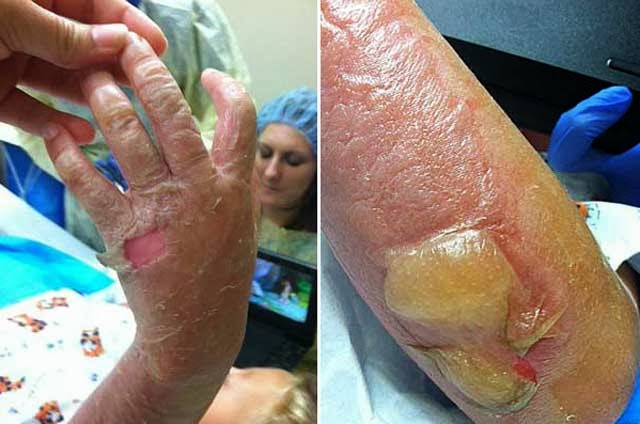
It's exactly what the word says - skin (derma) inflammation (itis) caused by exposure to plants (phyto) and sunlight (photo).  My wife has experienced it after brusing against rue in our garden (which we raise for the Black Swallowtails).  Other plants capable of photosensitizing human skin are listed in the Wikipedia entry, and include wild parsnip (which we encounter frequently while hiking in our part of the Midwest), parsley, celery, lemon, and lime.

The photos above are from a report on a group of children burned after playing with lime juice.
What at first seemed to be overexposure to the sun blossomed into softball-sized blisters and second-degree burns. Her girls, Jewels, 12, and Jazmyn, 9, wound up spending several days in an intensive care unit, hooked up to morphine to manage the pain...

A neighbor had a large lime tree that grew over the fence into the backyard where the girls went swimming. They had picked some of the fruits and squeezed them out into imaginary tea cups in their play lemonade stand... She remembered the girls crushing the fruits, juice sliding down their arms, splashing their legs, hitting their faces. 
The tricky part is that even after initial clinical resolution, the victim has to minimize exposure to sunlight because the light can cause recrudescence of the lesions even without reexposure to the sensitizer.

Via Nothing to do with Arbroath.

الاثنين، 23 سبتمبر 2013

"Mountain Dew mouth"

From a story at NPR:
[O]ver in Appalachia, the region that stretches roughly from southern New York state to Alabama, the fight against soda is targeting an altogether different concern: rotted teeth. Public health advocates say soft drinks are driving the region's alarmingly high incidence of eroded brown teeth — a phenomenon dubbed "Mountain Dew mouth," after the region's favorite drink...

Dentists have also found that the effects of soda on teeth are strikingly similar to the effects of methamphetamine or crack on teeth... Drinking more than a soda a day raises the risk that found in many soft and energy drinks will eat away at your tooth enamel and its pearly white color...

Harris says that dental problems are especially bad because dental care is harder to get in Appalachia, which includes many of the poorest and most remote communities in the country. Many people don't trust the well water in their homes because of pollution concerns and probably drink more soda because of it...
More information at the link.  Photo from a related article at First Choice Dental.

الخميس، 19 سبتمبر 2013

Gut Fermentation Syndrome

As reported in the International Journal of Clinical Medicine, via NPR:
A 61-year-old man — with a history of home-brewing — stumbled into a Texas emergency room complaining of dizziness. Nurses ran a Breathalyzer test. And sure enough, the man's blood alcohol concentration was a whopping 0.37 percent, or almost five times the legal limit for driving in Texas.

There was just one hitch: The man said that he hadn't touched a drop of alcohol that day...

So the team searched the man's belongings for liquor and then isolated him in a hospital room for 24 hours. Throughout the day, he ate carbohydrate-rich foods, and the doctors periodically checked his blood for alcohol. At one point, it rose 0.12 percent. Eventually, McCarthy and Cordell pinpointed the culprit: an overabundance of brewer's yeast in his gut...

The patient had an infection with Saccharomyces cerevisiae, Cordell says. So when he ate or drank a bunch of starch — a bagel, pasta or even a soda — the yeast fermented the sugars into ethanol, and he would get drunk. Essentially, he was brewing beer in his own gut.
I'm not sure the term "infection" is proper here; probably better to say his intestines were colonized, presumably as a result of his avocational exposure to the yeast. Still, it's rather interesting.

الثلاثاء، 17 سبتمبر 2013

"Wind turbine syndrome" - organic or psychogenic?

The question is raised in a column at Salon:
Wind-turbine syndrome is the disease you’ve never heard of, and many will tell you it doesn’t exist. The diagnosis was only first named in 2006, but it’s become more common as its suspected cause proliferates: Wind power is America’s fastest-growing energy source, and some people insist it’s making them sick...

Kristen French investigated the phenomenon for New York magazine. Plenty of people, she found, were eager to testify to an array of symptoms:
In the past decade, hundreds of people who live near wind turbines in places like Massachusetts, New York, Wisconsin, and Japan have reported that the windmills are giving them a litany of ailments. The first complaints were recorded in 2003, when a British physician wrote an unpublished report about 36 people in the U.K. who said the turbines made them sick. Then, in 2004, a physician in Victoria, Australia, distributed questionnaires to 25 people living near local turbines, and three of them wrote back about severe stress, insomnia, and dizziness. Even some Scottish Buddhist monks have complained of symptoms, including dry retching and crying. Last summer, Tharpaland International Retreat Centre sold its land to Scottish Power after its monks found they were approximately 70 percent less able to meditate. 
The term “wind-turbine syndrome” was coined by a pediatrician who also happens to be married to an anti-wind activist, but French talked to pro-wind sufferers who claim to be suffering as well. Those affected, she writes, say they have sound reason to believe that turbines are the source of their troubles. “It’s caused by sound waves released when the giant turbine blades collide with the wind—not just the audible whooshing noise, but the rumbling vibrations created by a low-­frequency sound, or infrasound,” she explains.
But most sciences and doctors, along with the Centers for Disease Control and Prevention, either won’t acknowledge it or flat-out don’t believe it exists.
To be precise in the terminology, the syndrome does exist.  A syndrome is just a collection of symptoms, without an implication as to whether the symptoms reflect an organic disease.  The question is whether the syndnrome is caused by sound/infrasound, or by anxiety.

More at the Salon link.

الاثنين، 16 سبتمبر 2013

How addictive is morphine?

Research previously conducted on rats did not adequately control for the environment in which the rats were studied:
Alexander's hypothesis was that drugs do not cause addiction, and that the apparent addiction to opiate drugs commonly observed in laboratory rats exposed to it is attributable to their living conditions, and not to any addictive property of the drug itself. He told the Canadian Senate in 2001 that prior experiments in which laboratory rats were kept isolated in cramped metal cages, tethered to a self-injection apparatus, show only that "severely distressed animals, like severely distressed people, will relieve their distress pharmacologically if they can."

To test his hypothesis, Alexander built Rat Park, an 8.8 m2 (95 sq ft) housing colony, 200 times the square footage of a standard laboratory cage. There were 16–20 rats of both sexes in residence, an abundance of food, balls and wheels for play, and enough space for mating and raising litters. The results of the experiment appeared to support his hypothesis. Rats who had been forced to consume morphine hydrochloride for 57 consecutive days were brought to Rat Park and given a choice between plain tap water and water laced with morphine. For the most part, they chose the plain water. "Nothing that we tried," Alexander wrote, "... produced anything that looked like addiction in rats that were housed in a reasonably normal environment." Control groups of rats isolated in small cages consumed much more morphine in this and several subsequent experiments. 
Via garry's subposthaven.  There is a relevant discussion at Reddit.

Addendum:   A hat tip to Fletcher in Portugal for noting that the research described above has been summarized in a well-illustrated 40-page cartoon.

السبت، 14 سبتمبر 2013

"All expenses paid"


An achingly evocative video posted by Miss Cellania at Neatorama, where a commenter noted that the 792,000 thai bahts are equivalent to about 25,000 USD or 19,000 EUR or 16,000 GBP.

It's also a reminder that the financial problems contingent on life support and major medical catastrophes are not limited to the United States.