Google maintains a file of all of the logos they have used during the past ten years.
Bedbugs have become distressingly topical. The Ark in Space has a gallery of photos of the critters, and also of what their presence looks like on a mattress.
If you're not squeamish, the New England Journal of Medicine has a report of ocular loiasis, with a link to a video of the parasite wriggling in the conjunctiva.
A post at The Consumerist ponders a request for pre-tipping at a coffee house. Should one be expected to tip before receiving the service?
Physics Buzz explains how to create you own fire tornado.
Scientists needed to poison brown tree snakes in Guam, so they laced dead mice with acetominophen, and then parachuted them into the treetops.
At Slate's Moneyblog, an explanation of how millionaires and billionaires can incorporate or create partnerships to reap the tax advantages that are offered to small businesses.
Enceladus is a small moon circling Saturn. It has jets of water vapor shooting into space, suggesting the presence of liquid water beneath several miles of ice on the surface. It may be the most likely place in our solar system to find extraterrestrial life.
A discussion thread at Reddit explains the science and practical aspects of peroxide as a tooth whitener.
Some authorities are starting to crack down on texting - by lifeguards at public beaches. Deaths have occurred because the lifeguards were not watching the bathers.
Here's a complete list of the movies in the Criterion Collection. Many of the ones I have viewed have come with excellent optional overdubs of commentary by film critics or directors of the films; I'm not sure if that's true of the entire collection.
The Washington Post explains short sales of houses, in which a borrower sells a home for less than what is owed on the mortgage. Being "underwater" is of course common nowadays; the new thing is being allowed to sell under those circumstances.
The annual IgNobel Prize winners have been announced by the staff at the Annals of Improbable Research.
The Economist explains why the burgeoning development of India will change the world. "Optimists predict that it will be the next China, only friendlier and more democratic." Impressive graphs at the link, and a well-reasoned discussion. I should make this a regular blog post.
The Norton Project is a video about two young men who secretely steal and then totally restore their father's vintage motorcycle. The style of the video reminds me of This American Life.
Image credit: painting by Dutch master Lucas van Valkenborch, from the Silesian Museum in Opava.
الأحد، 3 أكتوبر 2010
Recent posts at Neatorama
Alexander the Great and his army apparently protected their chest from missile attack with a linothorax - laminated layers of linen.
If you ship or receive items by media mail, you need to be aware that the USPS is routinely opening and inspecting such packages for compliance with regulations. If an eBay seller says he will ship a non-media item to you via media mail, you may be responsible for cost of noncompliance.
Gapped teeth have become so fashionable that some people are having orthodontists create a gap between their front teeth.
The "Sunrise Fanfare" of Also Sprach Zarathustra, played by the Portsmouth Sinfonia group that I blogged here earlier this week.
For the bicycle enthusiast, a peek at (and link to) a book about The Modern Bicycle - published in 1876.
The replica of Michelangelo's David displayed at the Victoria and Albert Museum has a removable figleaf, created for use during visits by Queen Victoria.
An architect who lost his eyesight discovered that his skills as a blind person were of use to his fellow architects.
The unrelated photo is one I took of the large platform mound at Aztalan State Park.
If you ship or receive items by media mail, you need to be aware that the USPS is routinely opening and inspecting such packages for compliance with regulations. If an eBay seller says he will ship a non-media item to you via media mail, you may be responsible for cost of noncompliance.
Gapped teeth have become so fashionable that some people are having orthodontists create a gap between their front teeth.
The "Sunrise Fanfare" of Also Sprach Zarathustra, played by the Portsmouth Sinfonia group that I blogged here earlier this week.
For the bicycle enthusiast, a peek at (and link to) a book about The Modern Bicycle - published in 1876.
The replica of Michelangelo's David displayed at the Victoria and Albert Museum has a removable figleaf, created for use during visits by Queen Victoria.
An architect who lost his eyesight discovered that his skills as a blind person were of use to his fellow architects.
The unrelated photo is one I took of the large platform mound at Aztalan State Park.
الجمعة، 1 أكتوبر 2010
"Locked-room" mysteries
Yesterday evening my wife and I participated in a discussion group at our local library; the topic was "favorite mysteries." I offered two suggestions. The first was any of the John Dickson Carr locked-room mysteries. Carr was an American author from the classic era of the 1930s, who spent time in England and wrote somewhat in the British style. His claim to fame is that of being the acknowledged master of locked-room murders.
In 1981 seventeen well-known authors and reviewers of detective fiction were asked to rank the top "impossible crime" novels. The fourteen highest-rated novels are shown at this link. Five of them were written by John Dickson Carr (who also wrote as "Carter Dickson"). The highest-rated book was "The Three Coffins" (published in England as "The Hollow Men):
I collected the books as tattered used paperbacks by scouring dozens of old used-book stores. I quite prefer the old paperbacks not just because they're cheap, but because the cover illustrations (sometimes with maps on the back cover) are so good. There is a wonderful assemblage of John Dickson Carr covers at The Cover Browser.
For a list of 99 locked-room mysteries, go to The Locked Room Library.
The other suggestion I offered at the book discussion group was Iain Pears' An Instance of the Fingerpost, which I now realize I've not blogged yet. Perhaps tomorrow.
In 1981 seventeen well-known authors and reviewers of detective fiction were asked to rank the top "impossible crime" novels. The fourteen highest-rated novels are shown at this link. Five of them were written by John Dickson Carr (who also wrote as "Carter Dickson"). The highest-rated book was "The Three Coffins" (published in England as "The Hollow Men):
One wintry night in London, two murders are committed in quick succession. In both cases, the murderer has seemingly vanished into thin air.I collected and read all the John Dickson Carrs about 15 years ago, and have saved them all on one bookshelf, looking forward to the day when I've totally forgotten the solutions and I can read them all again. That day has probably already arrived, but I'm busy blogging now.
In the first case, he has disappeared from Professor Grimaud's study after shooting the professor—without leaving a trace, with the only door to the room locked from the inside, and with people present in the hall outside the room. Both the ground below the window and the roof above it are covered with unbroken snow.
In the second case, a man walking in the middle of a deserted cul-de-sac at about the same time is evidently shot at close range, with the same revolver that killed Grimaud and only minutes afterward, but there is no one else near the man; this is witnessed from some distance by three passersby...
I collected the books as tattered used paperbacks by scouring dozens of old used-book stores. I quite prefer the old paperbacks not just because they're cheap, but because the cover illustrations (sometimes with maps on the back cover) are so good. There is a wonderful assemblage of John Dickson Carr covers at The Cover Browser.
For a list of 99 locked-room mysteries, go to The Locked Room Library.
The other suggestion I offered at the book discussion group was Iain Pears' An Instance of the Fingerpost, which I now realize I've not blogged yet. Perhaps tomorrow.
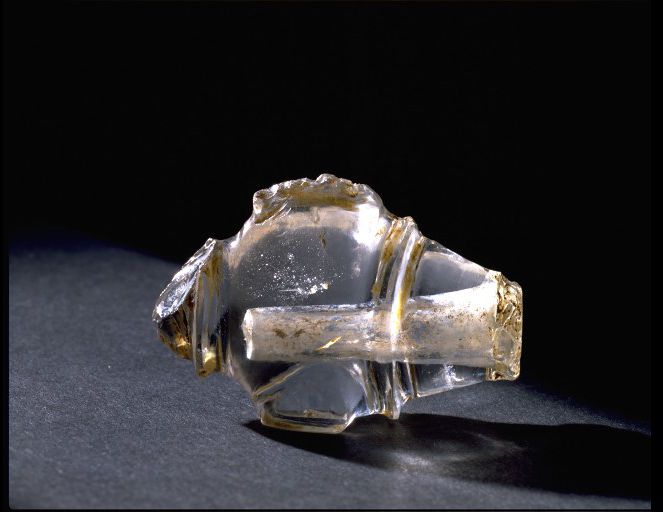
9th century flask
From the collections of the Victoria and Albert Museum, this small flask is thought to be of Egyptian or Iraqi origin in the late 9th or early 10th centuries.
This small rock crystal container is one of group of similar items shaped like a fish. The animal has a fin along its back and two deeply carved bands divide it into head, body and tail. The container has a horizontal hole drilled into the body from one end. This piece may have been used as a pot for a cosmetic such as kohl. Kohl was applied with a tiny rod that would have fitted into the hole.
Governor Schwarzenegger decriminalizes marijuana possession
California Gov. Arnold Schwarzenegger (R) Thursday [9/30] signed into law a bill that decriminalizes the possession of up to one ounce of marijuana. The bill reduces simple possession from a misdemeanor to an infraction.
Currently, small-time pot possession is "semi-decriminalized" in California. There is no possible jail sentence and a maximum $100 fine. But because possession is a misdemeanor, people caught with pot are "arrested," even if that means only they are served a notice to appear, and they must appear before a court.
That has happened to more than a half million Californians in the last decade, and more than 60,000 last year alone. Every one of them required a court appearance, complete with judge and prosecutor. That costs the cash-strapped state money it desperately needs.
Under the bill signed today... pot possession will be treated like a traffic ticket. The fine will remain at $100, and there will be no arrest record.
In a signing statement, Schwarzenegger said he opposed decriminalization for personal use—and threw in a gratuitous jab at Proposition 19, the tax and regulate marijuana legalization initiative—but that the state couldn't afford the status quo...
The law goes into effect January 1.
Addedum: His signing statement.
"Gameday" - as seen by Stephen Fry
Fry appears to be delightfully overwhelmed by the spectacle of American collegiate football. One has to admit, however, that if you're looking to find the absolutely most "over-the-top" venue to film, the Auburn-Alabama game would have to be one of the classics.
Which reminds me, for the rest of the season I'll be doing less blogging than usual on Saturdays, Sundays, and Monday nights.
The First Great Awakening
Alright, class. Since so many of you missed the question on this week's quiz, it's time for some remedial reading. We start with Wikipedia -
The First Great Awakening (or The Great Awakening) was a religious revitalization movement that swept the Atlantic world, and especially the American colonies in the 1730s and 1740s, leaving a permanent impact on American religion. It resulted from powerful preaching that gave listeners a sense of personal guilt and of their need of salvation by Christ. Pulling away from ritual and ceremony, the Great Awakening made religion intensely personal to the average person by fostering a deep sense of spiritual guilt and redemption, and by encouraging introspection and a commitment to a new standard of personal morality. It brought Christianity to African slaves and was an apocalyptic event in New England that challenged established authority. It incited rancor and division between old traditionalists who insisted on the continuing importance of ritual and doctrine, and the new revivalists, who encouraged emotional involvement and personal commitment. It had a major impact in reshaping the Congregational church, the Presbyterian church, the Dutch Reformed Church, and the German Reformed denomination, and strengthened the small Baptist and Methodist denominations. It had little impact on Anglicans and Quakers.And some details from the Revival Library:
The American Colonists had their own peculiar problems. They were a mixed collection of nationalities in an alien country. They had no central government to bind them together in anything like a national unity and were divided by intense religious convictions and by their nationalistic spirit. Perpetual war with the Indians produced all manner of inhuman passions, removing moral convictions and restraints. A wild and adventurous spirit possessed the people as morals declined and religion decayed. Drunkenness, swearing, immorality, and every form of vice blossomed as never before in their history. The godly aspirations of their Puritan forefathers for a Christian Utopia in the New World had long since died...The answer to the quiz question was Jonathan Edwards, but the image I've embedded above is that of his colleague, George Whitefield, who has a much more impressive peruke.
This revival began with the Theodore Frelinghuysen, a Dutch reformed Pietist, and was spread to the Scottish-Irish Presbyterians under the ministry of Gilbert Tennent, whose father, William, founded the famous ‘Log College’, which later became the Princeton University. The fire leapt over to the Baptists of Pennsylvania and Virginia before the extraordinary awakening that began in Northampton, Massachusetts, under the ministry of Jonathan Edwards in December 1734...
Edwards’s says the town experienced a ‘degenerate time’ with ‘dullness of religion.’ The young people were addicted to ‘night walking, tavern drinking, lewd practices and frolics among the sexes for the greater part of the night. Family government did too much fail in the town.’ Community leaders were locked in bitter disputes. Then, two well-known young people died untimely deaths in the spring of 1734. This had a remarkable sobering effect on the whole town and people began to ask questions about the meaning of life, life after death, eternity and other spiritual matters...
Edwards began to preach the Gospel deliberately and powerfully in a series on ‘justification by faith alone.’ In December 1734 six young people were converted. One was a young woman who was quaintly described as ‘one of the greatest company keepers in the whole town.’ Her life was so radically changed that it became the talk of the town and the news of this evident act of God’s grace spread like wildfire...
This was the beginning of a revival that was revitalised with a second wave in the 1740’s. In New England alone ten percent of the total population of 300,000 were added to the churches between 1740 and 1742. Total converts to Christianity reached 50,000 out of a total of 250,000 colonists in New England . It is estimated that a further 30,000 souls were converted through George Whitefield’s numerous visits to America from 1739 onwards. 150 new Congregational churches were established in twenty years.
The increase of Baptist churches in the last half of the century, was still more wonderful, rising from 9 to upwards of 400 in number, with a total of thirty thousand members. There was a similar growth in the Presbyterian and other churches.
الاشتراك في:
الرسائل (Atom)