Two photos from the Nikon Small World photomicrography competition for 2013. The top image is of a polished slab of Teepee Canyon agate (credit Doug Moore, UW Stephens Point).
The second one puzzles me. It is a thin section of a dinosaur bone preserved in clear agate (credit Ted Kinsman, Rochester Institute of Technology). I am surprised that the geologic processes that form an agate wouldn't destroy the fine structure of bone matrix. You learn something every day.
إظهار الرسائل ذات التسميات art. إظهار كافة الرسائل
الخميس، 14 نوفمبر 2013
الثلاثاء، 12 نوفمبر 2013
The Munich Nazi art trove
The trove of famous art has been much in the news this past week. One of the better discussions is a four-part set of articles in Der Spiegel:
In February 2012, German authorities raided the apartment of 75-year-old collector Cornelius Gurlitt and seized 1,406 works of art, a spectacular trove with a value that has yet to be estimated. It includes works by Liebermann, Marc Chagall, Franz Marc, Karl Schmidt-Rottluff, Max Beckmann, Emil Nolde, Picasso and Henri Matisse, among others. There were also many prints and graphic works, which Gurlitt had kept in a cabinet.
At the press conference, it was not clear what exactly the collector was being accused of. There is talk of tax evasion and embezzlement, but the legal framework for the authorities' confiscation of the collection seems murky at best.Image (cropped from the original photo) is of a reproduction of a painting by Otto Dix that Hitler and his henchmen considered to be "degenerate" art.
السبت، 9 نوفمبر 2013
"Prufrock" in cartoon format
One of my favorite poems - and the only poem displayed on a bulletin board in my home office - is T.S. Eliot's The Love Song of J. Alfred Prufrock. The poem is now being adapted into graphic format by cartoonist Julian Peters:
"The adaptation plays with literal versions of many of the things described in the poem, capturing its humor and poignance."Approximately the first third of the poem has been completed, and is viewable here.
(For the full text, see my 2012 post on "Spooning - and Prufrock."
Via BoingBoing.
الجمعة، 8 نوفمبر 2013
Neurons terminating in muscle tissue
A marvelous image to illustrate the term "arborizing."
From the Nikon Small World photomicrography competition for 2013. I love browsing through the galleries each year because of the seemingly endless (but not unenjoyable) hours I spent peering through a microscope during my graduate education and faculty years.
Audrey Hepburn in the kitchen and Mark Twain in the garden
Oddly, what caught my eye (after Ms. Hepburn of course) was the garbage can, which reminded me that once-upon-a-time garbage cans were lined with newspapers, not with pull-closure plastic bags. And they used to be small, not 30 gallons in size.
The photo comes from an imgur gallery of 29 colorized famous photos, some of them quite remarkably done, including this one of Mark Twain in a garden:
The others are worth browsing.
الجمعة، 1 نوفمبر 2013
"Deposit candy here"
A child's clever Halloween costume (note the feet).
Image cropped from the original posted by the child's mother, MoobyTheGoldenCalf, at Reddit.
الأربعاء، 30 أكتوبر 2013
A programmable automaton from the 18th century
This interesting and less-than-five-minutes video is an excerpt from a full BBC documentary by Professor Simon Schaffer of Cambridge. It features "The Writer," a cam-guided, programmable automaton by Pierre Jacquet-Droz:
The writer is the most complex of the three automata. Using a system similar to the one used for the draughtsman for each letter, he is able to write any custom text up to 40 letters long (the text is rarely changed; one of the latest instances was in honour of president François Mitterrand when he toured the city). The text is coded on a wheel where characters are selected one by one. He uses a goose feather to write, which he inks from time to time, including a shake of the wrist to prevent ink from spilling. His eyes follow the text being written, and the head moves when he takes some ink.The full, hour-long documentary is here. A tip of the blogging hat to reader Alex O. for bringing the link to my attention.
الخميس، 24 أكتوبر 2013
A newly discovered Leonardo da Vinci painting?
As reported in The Telegraph:
The painting, which depicts Isabella d’Este, a Renaissance noblewoman, was found in a private collection of 400 works kept in a Swiss bank by an Italian family who asked not to be identified. It appears to be a completed, painted version of a pencil sketch drawn by Leonardo da Vinci in Mantua in the Lombardy region of northern Italy in 1499. The sketch, the apparent inspiration for the newly found work, hangs in the Louvre Museum in Paris...
Scientific tests suggest that the oil portrait is indeed the work of da Vinci, according to Carlo Pedretti, a professor emeritus of art history and an expert in Leonardo studies at the University of California, Los Angeles. “There are no doubts that the portrait is the work of Leonardo,” Prof Pedretti, a recognised expert in authenticating disputed works by da Vinci, told Corriere della Sera newspaper.
Martin Kemp, professor emeritus of the history of art at Trinity College, Oxford, and one of the world’s foremost experts on da Vinci, said if the find was authenticated it would be worth “tens of millions of pounds” because there are only 15 to 20 genuine da Vinci works in the world. But he raised doubts about whether the painting was really the work of Leonardo. The portrait found in Switzerland is painted on canvas, whereas Leonardo favoured wooden boards...More details at the link.
There are further doubts – Leonardo gave away his original sketch to the marquesa, so he would not have been able to refer to it later in order to paint a full oil version. “You can’t rule out the possibility but it seems unlikely,” Prof Kemp said. It was more likely to have been produced by one of the many artists operating in northern Italy who copied Leonardo’s works.
الاثنين، 21 أكتوبر 2013
Sculpting with straw
From Kotaka, which has many more examples assembled in a gallery, via Neatorama.It's fall in Japan. And like every fall, rice is harvested, leaving behind straw to be hung and dried. In some rural areas, though, the rice straw has a special use: Making giant beasts.Kagawa Prefecture and Niigata Prefecture have the most famous "straw art festivals," which are large straw sculpture displays.Traditionally, straw was used to thatch roofs. In much the same manner, these straw sculptures are thatched around wooden frames.
الجمعة، 20 سبتمبر 2013
Images from The Getty's Open Content Program
Alexander the Great in the Air; Unknown; Regensburg, Bavaria, Germany, Europe; about 1400 – 1410 with addition in 1487; Tempera colors, gold, silver paint, and ink on parchment.
In a scene representing one of the stories from the legend of Alexander the Great most popular in the Middle Ages, the world conqueror, dressed as a European monarch might be, is pulled aloft by a pair of griffins and an angel. They hover precariously over a sea filled with an entertaining variety of fish and other creatures. The artist emphasizes the strange chair's upward movement as it carries the group out of the square framework of the miniature and takes off into the text.
A Harvest of Death; Timothy H. O’Sullivan, American, about 1840 – 1882, Print by Alexander Gardner, American, born Scotland, 1821 – 1882; negative July 4, 1863; print 1866; Albumen silver print.
Although Gardner's caption identifies the men in the photograph as "rebels represented...without shoes," they are probably Union dead. During the Civil War, shoes were routinely removed from corpses because supplies were scarce and surviving troops needed them.The two images I've embedded are from a selection of about twenty assembled at Public Domain Review.
In August of this year The Getty announced the launch of their Open Content Program which sees more than 4500 images from their collection made available under an open license, meaning anyone can share the images freely and without restriction.A wonderful resource for bloggers and the intellectually curious.
الاثنين، 16 سبتمبر 2013
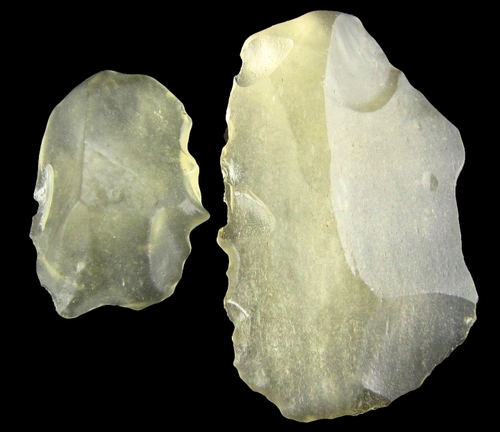
Paleolithic tools (scrapers) made from Libyan desert glass
From the Wikipedia entry on Libyan desert glass:
The origin of the glass is a controversial issue for the scientific community, with many evolving theories. Meteoritic origins for the glass were long suspected, and recent research linked the glass to impact features, such as zircon-breakdown, vaporized quartz and meteoritic metals, and to an impact crater. Some geologists associate the glass not with impact melt ejecta, but with radiative melting from meteoric large aerial bursts. If that were the case, the glass would be analogous to trinitite, which is created from sand exposed to the thermal radiation of a nuclear explosion. The Libyan desert glass has been dated as having formed about 26 million years ago. It was knapped and used to make tools during the Pleistocene Era.These two specimens were sold by Crystal Circle, via Bijoux et Mineraux.
الأربعاء، 11 سبتمبر 2013
الأربعاء، 4 سبتمبر 2013
17th century Japanese gold lacquer chest, used as TV stand and bar
"Around 1640, chief of the mission of the Dutch East India Company François Caron commissioned a group of gold lacquer boxes from the Kaomi Nagashige of Kyoto, a master craftsman who was the official lacquer-maker to the Tokugawa rulers... Because he was in Shogun Tokugawa Iemitsu’s good graces, Caron was able to secure the finest quality of lacquer, the kind of thing that would normally be seen in the palaces of the Shogun. The chests were decorated with gold, silver and copper foil, sheets and powder and mother of pearl. The painstaking process of creating these marvels took at least two years... "
...in 1643, the lacquer boxes left Japan for the Netherlands...the chests passed by descent through the family until they were purchased in a French Revolutionary fire sale by a haberdasher who sold them to the wealthy British writer and art collector William Beckford....
[A] Polish doctor named Zaniewski...bought it from the Cory auction for a pittance. In 1970, Dr. Zaniewski sold the chest for £100 to a tenant of his, a French engineer who worked for Shell Petroleum. The engineer used it as a TV stand in his South Kensington apartment for 16 years, then brought it with him when he retired to the Loire Valley in 1986. There he used it as a bar...Further detaiils at The History Blog.
At the June 9th auction held at the Château de Cheverny in the Loire Valley, the Mazarin Chest sold for 7.3 million euros ($9,544,000)...
الثلاثاء، 3 سبتمبر 2013
This is a "hachure map"
Somewhere this weekend I ran across a reference to a "hachure" on a map, and had to look it up. I assumed it had something to do with "cross-hatching" for shading. Not quite.
Hachures are an older mode of representing relief. They show orientation of slope, and by their thickness and overall density they provide a general sense of steepness. Being non-numeric, they are less useful to a scientific survey than contours, but can successfully communicate quite specific shapes of terrain. They are a form of shading, although different from the one used in shaded maps...
Hachures are strokes (short line segments or curves) drawn in the direction of the steepest slope (the aspect direction). Steeper slopes are represented by thicker, shorter strokes, while gentler slopes are represented by thinner, longer and farther apart strokes. A very gentle slope or a flat area, like the top of a hill, are usually left blank. The hachures are traditionally monocolour, usually black, gray or brown; using two complementary colours for the hachures on a neutral background colour (e.g. black and white lines on gray map colour) would give a shading effect as if the relief were illuminated.
In representing relief with hachures on a map, six rules are to be followed, according to G.R.P. Lawrence (1979):
The hachures are drawn in the direction of the steepest gradient.
The hachures are arranged in rows perpendicular to their direction.
The length and thickness of each stroke represents the drop in height along its direction: a short and thick stroke represents a short and steep slope, while a long and thin stroke represents a long and gentle slope.
The strokes are spaced at an equal distance inside a row.
The strokes have the same thickness inside a row.
If the map is illuminated, strokes are thinner and farther apart on the illuminated side.You learn something every day.
السبت، 31 أغسطس 2013
Axons
A 2013 BioArt winner at FASEB.John D. Olson, Paul W. Czoty, Michelle Bell
Wake Forest University School of Medicine, Winston-Salem, NCDiffusion Tensor Imaging (DTI) is an advanced form of magnetic resonance imaging (MRI) capable of mapping the direction of water motion in tissues. Fiber tracking is a specific method of assembling DTI data to study the three-dimensional architecture of the brain. This DTI fiber tracking image shows the brain of a living female cynomolgus monkey, collected as part of a study designed to determine whether cocaine use causes long-term changes to the brain’s structure and connectivity. Color indicates the direction that the axons (the brain cells’ long “arms”) are travelling: red is left to right, green is front to back, and blue is top to bottom.
A remarkable V-12 engine
After receiving a Cda-Projects Grant [Eric van Hove] headed to Morroco to create V12 Laraki, an excruciatingly detailed Mercedes V12 engine built from 53 materials that were hand-forged from 35 master craftsmen from various regions in Morocco.Via Just a car guy.
Nine months in the making,V12 Laraki began when van Hove dismantled a mercedes engine and then set about creating faithful reproductions of every single component, some 465 parts and 660 bolts made of casted copper. Contracting with artists around Morocco the engine was made with white cedar wood, high Atlas red cedar wood, walnut wood, lemon wood, orange wood, ebony wood of Macassar, mahogany wood, thuya wood, Moroccan beech wood, pink apricot wood, mother of pearl, yellow copper, nickel plated copper, red copper, forged iron, recycled aluminum, nickel silver, silver, tin, cow bone, goat bone, malachite of Midelt, agate, green onyx, tigers eye, Taroudant stone, sand stone, red marble of Agadir, black marble of Ouarzazate, white marble of Béni Mellal, pink granite of Tafraoute, goatskin, cowskin, lambskin, resin, cow horn, rams horn, ammonite fossils of the Paleozoic from Erfoud, Ourika clay, geometric terra cotta with vitreous enamel (zellige), green enamel of Tamgrout, paint, cotton, argan oil, cork, henna, rumex. In case you were interested.
While the engine is of course not meant to be functional, the piece acts as an incredible testament to Moroccan craft, as well as a fascinating amalgam of natural resources and materials found in the region.
الأربعاء، 21 أغسطس 2013
الثلاثاء، 20 أغسطس 2013
Ceremonial helmet of Emperor Charles V (1540)
There is no more splendid example of European dress as high political propaganda than the ceremonial armor made for the Hapsburg Holy Roman Emperors Maximilian I and Charles V and for Charles’ son, Philip II of Spain. They employed the greatest sculptural metalworkers on the continent... Such armor was rarely intended as practical protection during battle; rather it had a starring role in parades, jousting tournaments and court rituals and was favored attire for official portraits.This helmet was crafted by Desiderius Helmschmid and is now in the collections of the Patrimonio Nacional, Real Armería, Madrid. Image via Uncertain Times.
"Our banner in the sky"
A Civil War-era (1861) painting by famed landscape painter Frederic Edwin Church, currently in the Smithsonian American Art Museum, from the collection of Fred Keeler, via Salon.
الثلاثاء، 13 أغسطس 2013
I don't think that's a fig leaf...
This image is from a book with biblical history made around 1455. It contains a staggering 180 coloured drawings from the Old Testament, this one showing God creating Adam. As you can see, the decorator did not want us to see all parts Adam was given: he covered his private parts with a leaf. It was appropriate to do so, since the text itself (the Bible) mentions how a fig leaf was used for this very purpose. What is so great about this picture, however, is that the leaf is still attached to a plant.Fig leaves come from fig trees. That plant looks more like a Venus flytrap...
Image cropped from the original at Erik Kwakkel.
الاشتراك في:
الرسائل (Atom)