‏إظهار الرسائل ذات التسميات archaeology. إظهار كافة الرسائل

الاثنين، 16 سبتمبر 2013

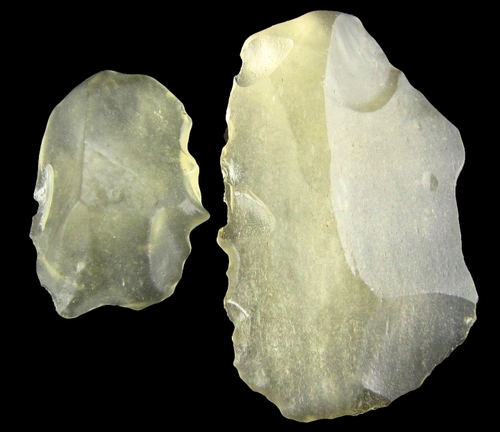
Paleolithic tools (scrapers) made from Libyan desert glass


From the Wikipedia entry on Libyan desert glass:
The origin of the glass is a controversial issue for the scientific community, with many evolving theories. Meteoritic origins for the glass were long suspected, and recent research linked the glass to impact features, such as zircon-breakdown, vaporized quartz and meteoritic metals, and to an impact crater. Some geologists associate the glass not with impact melt ejecta, but with radiative melting from meteoric large aerial bursts. If that were the case, the glass would be analogous to trinitite, which is created from sand exposed to the thermal radiation of a nuclear explosion. The Libyan desert glass has been dated as having formed about 26 million years ago. It was knapped and used to make tools during the Pleistocene Era. 
These two specimens were sold by Crystal Circle, via Bijoux et Mineraux.

A field "teeming with Bronze Age gold rings"

Amateur archaeologists Hans Henrik Hansen and his nephew Christian Albertsen were exploring a field near the Danish village of Boeslunde, southwestern Zealand, with metal detectors this June 18th when they discovered two bracelet-sized gold rings. They immediately brought the rings to the Zealand Museum where curator Kirsten Christensen recognized them as “oath rings,” arm rings that are open-ended with decorated funnel-shaped tips. Hansen and Albertsen told her they were off to find more of them and returned to the field the next day where they found another two rings within meters of the first two. They are from the Late Bronze Age and date to around 800 B.C...

The four rings are all different, although they do share some decorative features like meander patterns, snaking bend patterns like a river seen from above. Those meander patterns are a stylistic feature of Late Bronze Age (950-800 B.C.) metal work, which is how the rings were dated. The rings all show significant wear, especially on the tips were some of the decoration has been almost entirely eroded away, which means they were not made solely for sacrifice in a religious ritual... 
From Science Nordic (where there are additional closeup photos and a map of the Zealand region), via The History Blog

الثلاثاء، 10 سبتمبر 2013

Norwegian ice patch archaeology


For several years I've been reading about and writing posts about "ice patch" archaeology - the harvesting of ancient artifacts from areas where retreating ice has exposed the surface of the ground.  Spectacular items have been recovered in the Yukon and other circumpolar countries. This week Archaeology features an extended (7-page) report on items discovered in Norway:
In Scandinavia and beyond, the booming field of glacier and ice patch archaeology represents both an opportunity and a crisis. On one hand, it exposes artifacts and sites that have been preserved in ice for millennia, offering archaeologists a chance to study them. On the other hand, from the moment the ice at such sites melts, the pressure to find, document, and conserve the exposed artifacts is tremendous. “The next 50 years will be decisive,” says Albert Hafner, an archaeologist at the University of Bern who has excavated melting sites in the Alps. “If you don’t do it now they will be lost.”..

Usually the finds amounted to little more than an arrow here or a spear there—isolated misfires lost in the snow in times past. But since that first prehistoric shoe turned up in 2006, archaeologists have found more than 1,600 artifacts in Oppland County alone, sometimes hundreds at a time. Pilö said Oppland’s finds represent more than half the total number found so far in ice patches worldwide...

The archaeologists have found hundreds of “scare sticks,” wooden stakes with flat wooden shingles attached to them by string so the shingles blow around in the wind. The sticks were planted in the snow in long rows. According to an eighteenth-century report from a Danish missionary in Greenland, the unfamiliar moving objects unsettled the reindeer just enough—without spooking them—to guide them toward stone hunting blinds, where hunters waited with bows or spears...

Moss-covered rock cairns... mark a trail across the pass that people and their livestock may have used for centuries. The team found plenty of evidence of high-mountain traffic, from that Bronze Age shoe to a Viking mitten, an elaborately carved walking stick, fragments of a ski, and copious horse and sheep dung...

It is tempting to think of all these melting sites as glaciers, and the field as “glacier archaeology,” but that is a bit of a misnomer... Ice patches, however, are stationary accumulations of snow and ice, often in isolated basins or on shady mountainsides. Centuries of snowfall accumulate and freeze, creating blocks of ice that can be 65 feet thick or more. Artifacts lost or left in the snow atop an ice patch don’t get churned as they would in a glacier...

Among the items preserved by the ice, fabric and leather are the most remarkable—and the most fragile. Wood artifacts may last a few years once they melt out of the ice, but for these items, the clock runs out much faster. “You really have to be there when the leather comes out, because it goes away very quickly,” Pilö said. “You have a week or less to recover leather—it dries out, becomes light and brittle, and blows away.”..
Much more at the link.

السبت، 10 أغسطس 2013

6th century gold female figurine

A field on the Danish island of Bornholm has in recent years been the site of many surprising archaeological finds. The most recent one of these was of a golden figurine of a naked woman. The small, heavily arched figurine is only 4.2 cm tall and weighs 3 grams, has many details and bears the mark of quality craftsmanship.

The woman has a long and slender body, which may have been made out of a thin bar of gold. The head is elongated with a protruding jaw and incised hair. The breasts are sagging and below both shoulders are notches, indicating that her arms have been tied around her body.

The arms are stretched and the thumbs are pressed against one another, while the other fingers are facing downwards. On the stomach is a more clearly incised belt decorated with a zig-zag pattern, and the private parts are clearly visible between the short and thin legs...
The golden woman is the fifth in a series of small, golden human figurines from the Smørenge field on Bornholm. The first four are all believed to depict men, while there is no doubt about the gender of the last addition to the series.
Text and images (credit René Laursen) from ScienceNordic, via The History Blog.

الجمعة، 9 أغسطس 2013

"Cat people" vampire burials

Archaeologists excavating the site of future road construction near the town of Gliwice in Silesia, southern Poland, discovered four skeletons buried with their heads between their knees. Stones were placed on the skulls. Further digging unearthed another nine skeletons buried with their heads out of place. Eleven were found with the skull between the legs, one with skull between the hands, two with the skull perched directly on the shoulders. Most of the skeletons found buried this way appear to be female.

Putting the head anywhere but on top of the neck was a common folk practice in Slavic countries for ensuring that the dead would not rise from the grave to harry the living. The idea was that if the dead person attempted to rise, without her head in place she wouldn’t be able to see his victims or even coordinate the climb out of the grave...

There were no grave goods, not even the remains of clothing like buttons, in the initial discoveries that could give an idea of when they were buried. The ritual was in regular use in Poland from the arrival of Christianity in the 10th century until the First World War (the last known vampire burial in Poland took place in the east-central village of Old Mierzwice in 1914), so that doesn’t help narrow it down...

Osteological examination has already returned extraordinary results: the eye sockets are much larger than average while the nasomaxillary area (the part between the nose and the upper jaw) is narrower than average. This would have given them a cat-like appearance, a genetic mutation that suggests the deceased are related and that might explain why this group of people were seen as dangerous by their community.
More information at The History Blog.

الجمعة، 2 أغسطس 2013

A wooden railway discovered in Newcastle


Fascinating; I'd never heard of these.  As reported in The History Blog:
Archaeologists excavating the site of the Neptune Shipyard in Newcastle upon Tyne, northeastern England, before development have discovered a 25-meter (82 feet) stretch of an 18th century wooden railway. These rails weren’t transporting trains — they wouldn’t be invented until the next century — but rather wooden wagons, aka chaldrons, pulled by horses. This is a section of the Willington Waggonway built in the 1760s to transport coal from several local collieries to the river Tyne...

...the networks of waggonways were essential to the development of the industry. They enabled collieries to transport far more coal than wagons on traditional roads. One horse could deliver between 10 to 13 long tons of coal per trip along the waggonways, four times more than that same horse could deliver off track. They were built like Roman aqueducts, at a slight downhill incline from colliery to dock, whenever possible so gravity could help drive the wagons...

 It’s a discovery of major historical significance, not just because of its importance to the history of the region, but because the rail gauge is standard gauge, still the most widely used rail width in the world... 
More information at The History Blog, especially re the development of standard gauge.  You learn something every day.

Photo cropped from the original at The Journal.

الخميس، 11 يوليو 2013

Ancient pyramid destroyed

A construction company has essentially destroyed one of Belize's largest Mayan pyramids with backhoes and bulldozers to extract crushed rock for a road-building project, authorities announced on Monday.

The head of the Belize Institute of Archaeology, Jaime Awe, said the destruction at the Nohmul complex in northern Belize was detected late last week. The ceremonial centre dates back at least 2,300 years and is the most important site in northern Belize, near the border with Mexico.

"It's a feeling of incredible disbelief because of the ignorance and the insensitivity ... they were using this for road fill,'' Awe said. "It's like being punched in the stomach, it's just so horrendous.''..

"Just to realize that the ancient Maya acquired all this building material to erect these buildings, using nothing more than stone tools and quarried the stone, and carried this material on their heads, using tump lines,'' said Awe. "To think that today we have modern equipment, that you can go and excavate in a quarry anywhere, but that this company would completely disregard that and completely destroyed this building. Why can't these people just go and quarry somewhere that has no cultural significance? It's mind-boggling.''
Text from The Huffington Post.   Image from Past Horizons, via Reddit, where there are links to more pix.

الاثنين، 24 يونيو 2013

Stone ship

“Tjelvar’s grave”, Boge, Gotland, Sweden, 1938

Tjelvar’s Grave is one of the best preserved stone ship settings in Gotland. According the legend Tjelvar, the first man lived in Gotland, is buried there. Archaeologists have dated the grave to made in the late Bronze Ages, 1100-500 BC.

Tjelvar’s grave is 18 metres long and 5 metres wide. The height of the gunwale stones diminishes towards the centre of the ship, which has also been filled with stones to form a boat-deck. A plundered stone-slab coffin, containing cremated bones and a few potsherds, was uncovered in an excavation in the 1930s.
More info on stone ships

Photo by Mårten Stenberger, from the Flickr photoset of the Swedish National Heritage Board, via First Time User.

الثلاثاء، 2 أبريل 2013

The Escrick ring

The unique sapphire and gold ring discovered in Escrick, a town six miles south of York, by metal detectorist Michael Greenhorn in 2009 may be as much as 600 years older than previously believed. It also may be of continental European, probably French, origin and worn by royalty, not by a lord of the Church.

The ring’s mixture of styles and materials from different periods has befuddled researchers ever since it was discovered. Although there are no rings like it to make for a viable comparison, the layout, the gold beading, the use of the sapphire, garnet slivers and cloisonné red glass, initially suggested a date in late 10th or 11th century. The combination of red glass and blue glass in a gold setting, however, is typical of early Anglian jewelry (7th – 9th centuries) but they didn’t use sapphires. Experts thought the anomalous sapphire might have been a later addition replacing a blue glass element to increase the value of the ring and make it worthy of royalty...

There could be another explanation for the stylistic anomalies. For instance, the ring may have been created later, the 8th or 9th century, say, but was inspired by 5th or 6th century designs. The inspiration need not have been jewelry either. It could have been local Yorkshire stonework...

The research continues. Archaeologists and historians from the University of Durham will do further investigations of the find location for any information from the 5th or 6th centuries.
Text and image from The History Blog, which has further details.

الثلاثاء، 26 مارس 2013

The Panther Cave pictographs - enchanced 3D

Panther Cave is a rock shelter in Seminole Canyon State Park, Texas, named for a dramatic leaping cat that is the largest of its many pictographs. Copious overpainting indicates the site was used as a canvas by generations of rock painters. Cats, humans wearing headdresses, abstract figures from six inches to more than 10 feet high decorate the rock face. 

The images are predominantly in the Pecos River and Red Linear styles and date back about 4,000 years. Pecos River Style is the oldest, starting around 5000 years ago. Its iconography features monumental polychrome designs of zoomorphic figures and of anthropomorphic figures called shamans. Pecos River art is thought to have had ritual significance, perhaps having been painted for ceremonial religious purposes. Red Linear style is characterized by small red stick figures engaged in a variety of shared activities like hunting, fighting, sex and childbirth. Red Linear figures often incorporated the older large Pecos River animal figures in their scenes...

Acutely aware of the precarious situation Panther Cave and other rock art sites find themselves in, the SHUMLA Archeological Research and Education Center launched the Lower Pecos Rock Art Recording and Preservation Project in 2009... They used 3D modeling software to showcase the natural contours and shape of the cave, then used color enhancement to highlight the stunning complexity of figures that are not clear to the naked eye. The finished product is a riot of color, giving viewers whole new insight into the pictographs that layer the site.
Wow.

السبت، 2 مارس 2013

Can you explain this hollowed-out die? - answered


Presented as a challenge to retired dungeonmasters and ninth-level paladins.   The image is presented without further explanation in an Archaeology article about excavations in Naples, Italy.  Ancient Romans were well known for their propensity for gaming (type "Roman dice" into Google Images), but I've never seen a die hollowed out in this fashion.

It looks to have been made of ivory or bone, and unless it was created or adapted for some decorative purpose, the hollowing-out must have been intended for some functional purpose.  The two affected sides are for the 3- and 4-pips, with the latter evident on the image around the edges of the cavity, so I think it was still used as a six-sided die, not as a four-sided one.

One might assume that the hollowing was done to prove that the die was not asymmetrically weighted, but would it then still be a fair die?

And if it would not be a fair die on a throw, does that revert us back to the other option - that this was decorative, perhaps worn as a ring on a finger?

See also: A 20-sided die... from the 2nd century A.D.

Photo credit Pasquale Sorrentino.

Addendum:  An anonymous reader found this (unfortunately unsourced) similar die at The Cartographer


This one was "deliberately carved from a large animal bone with the marrow channel as a feature," and on the 3-pip side the hole became the central pip.

Addendum #2:  A big hat tip to MacGregor Historic Games for what appears to be the definitive answer to my question:
This was actually a fairly common technique to make larger dice out of marrow bones of sheep from Roman times and even later. This one is simply missing the two plugs or end caps that would be glued in place to cover the holes. The book "Face to Face with Dice" (ISBN: 90-76953-88-0) discusses them and has several pictures and illustrations. It explains that a sheep or goat metatarsal bone could be ground into a square "stick" and then cut into several cubes. The faces with three and four were usually placed on the caps.

There have been some writers who have thought that these might be "loaded" dice with a bit of lead glued inside to favor one number, but X-rays of complete examples have yet to find any weighted versions of this type of hollow dice. I assume the thickness of the end caps might compensate a bit for the balance being a little off, or that they may not be "off" enough to be reliably predictable as loaded dice.

Here are some pictures of some complete examples.
الجمعة، 1 مارس 2013

Paleolithic screw waterskin stoppers

These are the most delightful tools I have ever seen. They are from the Perigordian IV, which is 30 000 BP to 28 000 BP.  They are called 'goat skin corks' which have a hand cut screw thread!

I was staggered when I saw them, I was looking for something else, and came across them by chance. You don't expect to find a screw thread in the Palaeolithic! ..

They are from two different sites, but the same time period. My bet is that both were made at one site, and traded to another. No two people come up with an intellectual leap like that independently, at the same time. It had to have been made by the same artisan or group of artisans, for sure. What is interesting, however, is that this was invented, but never became popular except in one general area at one time, about 30 000 years ago...

The one on the left is from Roc de Combe-Capelle, and on the right from Fourneau du Diable. They are both in the Dordogne area, about 90 kilometres apart.

Notice that they are both right hand threads, showing that right handedness in humans has been around for a long time - though we knew that anyway because of the differences in arms on the right and the left of skeletons...

The material of both is ivory. Hard to work, but it would be very durable...
Text and image from Don's Maps, via For what they were, we are and Finest Kind Clinic and Fishmarket.  At the first via and at Noticias de Prehistoria, there's a photograph of another stopper, made of bone, where the threads are less perfect that those in the hand-drawing above, making me wonder if they were idealized somewhat by the artist.

الثلاثاء، 19 فبراير 2013

The world's oldest carved human face

Twenty-six thousand years ago in the Czech Republic, one of our ice-age ancestors selected a hunk of mammoth ivory and carved this enigmatic portrait of a woman - the oldest ever found.
From New Scientist.  Photo: Moravian Museum, Anthropos Institute.

الأربعاء، 23 يناير 2013

"Beaker vessels" for drinking holly extract

Coffee had not yet arrived in Europe from southern Arabia when Spanish explorers came to the southeastern United States and discovered that Native Americans were already drinking a highly caffeinated beverage. Called Black Drink, it was made from the toasted leaves of two species of llex (holly) and was used by many tribes as part of purification rituals that also included fasting and vomiting...

By analyzing residue left in the beaker vessels dating to as early as A.D. 1050 from which Black Drink was consumed, Crown’s team has shown that the local population of Cahokia, the largest pre-Columbian site north of Mexico, had in fact been imbibing the potent potable 500 years earlier than previously thought.
Photo credit: Linda Alexander and the Illinois State Archaeological Survey.

الثلاثاء، 22 يناير 2013

"Bog army" found in Denmark


From a report at ScienceNordic:
Archaeologists have spent all summer excavating a small sample of what has turned out to be a mass grave containing skeletal remains from more than 1,000 warriors, who were killed in battle some 2,000 years ago... The site is located in the Alken Enge wetlands near Lake Mossø on the Jutland peninsula.

The area that has so far been excavated contained bone fragments from around 240 men aged between 13 and 45. The men’s bones are marked by melee weapons such as swords and axes...  The marks from the predators’ bite indicate that the dead warriors were left to die and rot on the battlefield, without anyone bothering to bury or even remove the bodies...

One of the greatest historians of the Roman Empire, Tacitus (56 AD – 120 AD) described the aftermath of the Roman’s famous defeat in the Battle of the Teutoburg Forest in 9 AD.
“In the middle of the plain, bones lay either spread out or heaped, depending on whether they had fled or resisted. Next to the bones lay bits of spears and horse limbs, and there were also human heads nailed to trees. In the nearby groves were barbarian altars in which they had sacrificed tribunes and centurions of the first rank,” Tacitus wrote in his Annals...

“The bones are completely fresh,” he says. “Some DNA has been preserved, so we can get a good profile of what Iron Age man looked like. An anthropological analysis of the bones will provide us with a picture of their diet and their physical appearance.” ..

The project, titled ‘The army and post-war rituals in the Iron Age – warriors sacrificed in the bog at Alken Enge in Illerup Ådal’ is a collaboration between archaeologists and geologists at Skanderborg Museum, Moesgård Museum and Aarhus University.
Image cropped from the original in a gallery of 13 photographs at the source article.

الأربعاء، 16 يناير 2013

Roman gold coins found in England


These were found by a man who bought a simple metal detector and explored a farm field...
All of them are 22-carat gold solidus coins struck in Milan (capital of the Western Empire from 286 A.D. to 402 A.D) and Ravenna (capital of the Western Empire from 402 A.D. until the collapse in 476 A.D.) in the late 4th century. The solidi bear the names and faces of the five different emperors who issued them: Gratian, Valentinian, Theodosius, Arcadius and Honorius, the last Roman emperor to rule Britain. They are in incredible condition. When I first saw a thumbnail of the find, I thought they were double eagles or some other relatively recent gold minting. The high resolution picture confirms that they look as fresh as the day they were struck... [click the embed to enlarge]

Their condition is particularly impressive considering that they’ve almost certainly encountered the business end of farming equipment. The woodland where the coins were discovered has been quarried and farmed over the past two centuries, which is probably why the coins were found scattered over the area instead of together in a container...

Solidi were not circulation coins. Here’s David Thorold, Prehistory to Medieval Curator at Verulamium Museum, on the subject:
“Gold solidi were extremely valuable coins and were not traded or exchanged on a regular basis. They would have been used for large transactions such as buying land or goods by the shipload. “The gold coins in the economy guaranteed the value of all the silver and especially the bronze coins in circulation. If you saved enough bronze, you could exchange it for a silver coin. If you saved enough silver, you could exchange it for a gold coin. However, most people would not have had regular access to them. Typically, the wealthy Roman elite, merchants or soldiers receiving bulk pay were the recipients.”
The local museum will then be given the opportunity to purchase the treasure at the assessed value, with all proceeds split between the finder and the landowner.
Click on the pic to enlarge.  There were 159 coins in the final tabulation.  It's no wonder that ancient peoples coveted gold, if not for its rarity, then for its ability to retain its luster and beauty for indefinite periods of time.

Found at The History Blog.

الاثنين، 31 ديسمبر 2012

This is NOT the skull of an extraterrestrial alien

An archaeological discovery of 13 Conehead-shaped skulls in Mexico has people recalling the famed Saturday Night Live sketch. The bones, which are about 1,000 years old, dating back to 945 A.D. to 1308 A.D., were discovered accidentally during a dig for an irrigation system in the northwest state of Sonora in Mexico. While it’s not unheard of for archaeological sites to be unearthed during modern excavations, the misshapen skulls discovered on the site are fairly uncommon, especially as far north as Sonora. “This was a Hispanic cemetery with 25 skulls, and 13 of them have deformed heads,” Cristina Garcia Moreno, who worked on the project with Arizona State University, told ABC News. “We don’t know why this population specifically deformed their heads.”
Some news videos of the discovery have described the procedure of cranial deformation as a "rite of passage into adulthood," but clearly deformation to this degree has to be undertaken on a pliable skull of an infant.

There's more information at the Artificial Cranial Deformation page at Wikipedia, where I found the image at right ("Painting by Paul Kane, showing a Chinookan child in the process of having its head flattened, and an adult after the process") and these notes:
Early examples of intentional human cranial deformation predate written history and date back to 45,000 BC in Neanderthal skulls, and to the Proto-Neolithic Homo sapiens component (12th millennium BCE) from Shanidar Cave in Iraq.  It occurred among Neolithic peoples in SW Asia.  The earliest written record of cranial deformation dates to 400 BC in Hippocrates' description of the Macrocephali or Long-heads, who were named for their practice of cranial modification.

الأربعاء، 12 ديسمبر 2012

Prehistoric lyre bridge discovered


Archaeologists excavating the High Pasture Cave on the Isle of Skye have discovered a wooden fragment that they believe came from a lyre or similar stringed instrument. The fragment was burned and part of it broken off, but you can clearly see the carved string notches that identify it as a bridge. It was discovered in the rake-out deposits of the hearth outside the entrance to the cave. The deposits date to between 550 and 450 B.C., which would make the bridge a fragment of the oldest stringed instrument found in Europe...

Musical instruments from Iron Age Europe were not the luxury models of ancient Sumer nor did they have the advantage of a dry, hot environment to preserve the wood. Even Roman-era instruments are so hard to come by that we have to rely on literature, mosaics and frescoes to learn about them, or carvings on altars like the one unearthed in Musselburgh in 2010 which until now was the earliest representation of a musical instrument ever found in Scotland. Finding a piece of an instrument that is centuries older than any previous discoveries and is so clearly recognizable as a piece of an instrument (the bridge is probably the single most recognizable part of a lyre because of its shape and the string notches) is therefore enormously significant to our understanding of ancient music and poetry in Europe.
Text and image from The History Blog, where there is more information and additional relevant links.

الثلاثاء، 27 نوفمبر 2012

Petroglyph vandalism by human scum


From a report in the Los Angeles Times:
BISHOP, Calif. — Ancient hunters and gatherers etched vivid petroglyphs on cliffs in the Eastern Sierra that withstood winds, flash floods and earthquakes for more than 3,500 years. Thieves needed only a few hours to cut them down and haul them away.

Federal authorities say at least four petroglyphs have been taken from the site. A fifth was defaced with deep saw cuts on three sides. A sixth had been removed and broken during the theft, then propped against a boulder near a visitor parking lot.  Dozens of other petroglyphs were scarred by hammer strikes and saw cuts.
"The individuals who did this were not surgeons, they were smashing and grabbing," U.S. Bureau of Land Management archaeologist Greg Haverstock said last week as he examined the damage. "This was the worst act of vandalism ever seen" on the 750,000 acres of public land managed by the BLM field office in Bishop.

The theft required extraordinary effort: Ladders, electric generators and power saws had to be driven into the remote and arid high desert site near Bishop. Thieves gouged holes in the rock and sheared off slabs that were up to 15 feet above ground and 2 feet high and wide...

For generations, Paiute-Shoshone tribal members and whites have lived side by side but not together in Bishop. But desecration of the site, which Native Americans still use in spiritual ceremonies, has forced reservation officials and U.S. authorities to come together and ask a tough question: Can further vandalism be prevented?

The easy answer is to police the site and others listed under the Archaeological Resources Protection Act. But that's not possible given the condition of cash-strapped federal lands agencies, authorities said.
Embedded photo credit AFP/Getty Images, via The Telegraph.

الأربعاء، 31 أكتوبر 2012

The Ladies of Téviec

Téviec or Théviec is an island situated to the west of the isthmus of the peninsula of Quiberon, near Saint-Pierre-Quiberon in Brittany, France. The island is an important archaeological site due to its occupation during the Mesolithic period. Many archaeological finds have been made dating back to over 6,700 years before the present day, including the remains of over 20 people. One of the most remarkable finds was that of the grave of two young women who had apparently died violently but had received an elaborate burial under a "roof" of antlers, their bodies decorated with jewelry made from shells...

In another grave, the skeletons of two women aged 25–35, dubbed the "ladies of Téviec", were found with signs of violence on both. One had sustained five blows to the head, two of which would have been fatal, and had received at least one arrow shot between the eyes. The other had also traces of injuries. However, this diagnosis is disputed by some archaeologists, who have suggested that the weight of earth above the grave may have been responsible for damaging the skeletons.


The bodies had been buried with great care in a pit that was partly dug into the ground and covered over with debris from the midden. They had been protected by a roof made of antlers and provided with a number of grave goods including pieces of flint and boar bones, and jewellery made of sea shells drilled and assembled into necklaces, bracelets and ringlets for the legs. The grave assemblage was excavated from the site in one piece and is now on display at the museum of prehistory in Toulouse, where its restoration in 2010 earned a national award.