In September 1968, the budding rock star paid a Beverly Hills auto dealer $3,500 for the three-year-old sports car. When she bought it, the Porsche was a factory-painted "oyster white." For a flamboyant singer who wore rose-colored glasses and feather boas, that wouldn't do. So she got roadie Dave Richards to paint it with swirling psychedelic images, including Mount Tamalpais on one fender and a portrait of her with her band, Big Brother and the Holding Company, on another.More details about the history of the car at the YouTube "about" section, where my objection re the choice of the song in the video is anticipated by the comment that her iconic "my friends all drive Porches, I must make amends" lyrics couldn't be used because of copyright protection.
The singer's 1965 Porsche 356c Cabriolet, which she bought when she was living in Larkspur, is usually enshrined in the Rock and Roll Hall of Fame in Cleveland. It came to Marin from the Grammy Museum in Los Angeles, where it was on loan.
"They used regular house paint," Michael Joplin recalled. "They were just playing around, saying, 'Hey, let's make an art car.' They were having a lot of fun. It was a convertible, and she would drive it around with the top down. People would leave notes for her on it."
إظهار الرسائل ذات التسميات curiosities. إظهار كافة الرسائل
إظهار الرسائل ذات التسميات curiosities. إظهار كافة الرسائل
الجمعة، 8 نوفمبر 2013
Janis Joplin's psychedelic Porsche

الاثنين، 4 نوفمبر 2013
Opalized pine cone

"This beautiful specimen was found at... "Kens Retreat" in the Coocoran mining area N/West of Lightning Ridge..."Text and image from Opal Auctions, via Bijoux et Mineraux.
The centre of Australia used to be an inland sea. Miners now unearth opalized fossils from its hot dry deserts. Opalized fossils include vegetation or wood from Boulder Fields and opalized clam shells from Coober Pedy.
Opalized fossils also include sea shells, teeth, and even opalised belemnites (squid). Opalised shells with good colour and small amounts of potch are hard to find, and many are worth more if left natural and unpolished. Among the rarest are opalized pineapple, found only in White Cliffs Opal Fields."
Dice can "dramatically decompose"

Cellulose nitrate was used to make dice from the late 1860s until the middle of the twentieth century, and the material remains stable for decades. Then, in a flash, they can dramatically decompose. Nitric acid is released in a process called outgassing. The dice cleave, crumble, and then implode.
From Dice: Deception, Fate & Rotten Luck by Ricky Jay and Rosamond Purcell, 2002.After reading that I immediately checked my box of D&D dice, which have been sitting on the shelf for years. They all seem to be intact.
Text and image via Sutured Infection.
الثلاثاء، 29 أكتوبر 2013
The world's ten busiest air-travel routes in 2012
The data in chart form is at Amadeus:

Among other key findings, the study reveals that 22% of all global air travel is concentrated on just 300 origin and destination ‘super routes’, each of which carries over 1 million passengers annually. Furthermore, 69% of all global air travel is made on major routes with 100 thousand annual passengers...So, where are those "super routes"? VizualStatistix has plotted the top ten on a map, which I've placed below the fold to challenge you to name any one of those top ten routes before peeking (i.e. name the cities the planes fly between).

"Note that the lines are not geodesics; I curved path #7 so that you could see path #6 beneath it."
الخميس، 24 أكتوبر 2013
630 yards. Par 3.
The "Extreme 19th" is a supplemental golf hole at the Legend Golf and Safari Resort in South Africa. The tee - accessed by way of a helicopter ride - is at the top of a mountain, 430 meters above the green.
Different sources cite a "time for the ball to land" between 20-30 seconds, which seems way excessive for a 430 meter fall, assuming 9.8 m/s/s applies in South Africa. Top professionals have hang times of about 7 seconds on level ground, so this hole requires an additional 13-23 seconds. Presumably terminal velocity and perhaps updraft air currents muddy the pure math.
The leaderboard for the hole currently shows 8 birdies and about 100 pars.
Via Neatorama.
الاثنين، 30 سبتمبر 2013
The Leidenfrost Effect is endlessly fascinating
I've written about it before (see "How to dip your hand into liquid nitrogen") and was delighted to find at Nothing to do with Arbroath the above video, in which students at the University of Bath used the effect to create directional movement by droplets of water.
Today I also found a description of the effect from 1868:
Mr. Davenport informs us, that he saw one of the workmen in the King’s Dockyard at Chatham immerse his naked hand in tar of that temperature [220°]. He drew up his coat sleeves, dipped in his hand and wrist, bringing out fluid tar, and pouring it off from his hand as from a ladle. The tar remained in complete contact with his skin, and he wiped it off with tow...And found that the eponym comes from a German physician:
Mr. Davenport ascribes this singular effect to the slowness with which the tar communicates its heat, which he conceives to arise from the abundant volatile vapour which is evolved ‘carrying off rapidly the caloric in a latent state, and intervening between the tar and the skin, so as to prevent the more rapid communication of heat.’..
The workmen informed Mr. Davenport, that, if a person put his hand into the cauldron with his glove on, he would be dreadfully burnt, but this extraordinary result was not put to the test of observation.
"During his lifetime, Leidenfrost published more than seventy manuscripts, including De Aquae Communis Nonnullis Qualitatibus Tractatus (1756) ("A Tract About Some Qualities of Common Water") in which the Leidenfrost effect was first described (although the phenomenon had been previously observed by Herman Boerhaave in 1732)."
الجمعة، 27 سبتمبر 2013
An extremely clean harvestman

As reported by Susannah Anderson in her delightful blog Wanderin' Weeta (With Waterfowl and Weeds):
I took a blouse out of the washer and hung it to dry. This daddy-long-legs came running out of a fold. Good thing I used cold water and the gentle cycle.More photos at the link, along with this interesting question: "I wonder: does he run faster with shorter legs? Do those long, wobbly legs slow down his brothers?"
I saw him last night, roaming placidly around the bathroom; he looked duller then. Today, the first thing I saw was the flash of brick red. And he was panicking; I don't think I've ever seen a harvestman run as fast as he was before.
I don't have an answer, but I did find this interesting tidbit:
The legs continue to twitch after they are detached. This is because there are 'pacemakers' located in the ends of the first long segment (femur) of their legs. These pacemakers send signals via the nerves to the muscles to extend the leg and then the leg relaxes between signals. While some harvestman's legs will twitch for a minute, other kinds have been recorded to twitch for up to an hour. The twitching has been hypothesized as a means to keep the attention of a predator while the harvestman escapes.Just like a skink's tail. Cool.
الخميس، 19 سبتمبر 2013
Valuable serial numbers on currency
Excerpts from an interesting article at Boston.com:
Currency collectors pay handsomely for what they call “fancy” serial numbers—digits that they perceive as unusual or special...
The simplest fancy numbers are the early ones: The redesigned $100 note with serial number 00000001 is likely to fetch $10,000 to $15,000, according to Dustin Johnston, director of currency for Heritage Auctions in Dallas. A $20 bill that was first off the press in a 2009 run sold in April for $5,581. A $2 bill numbered 0000001 with a star—the star means it replaced a misprinted note with the same number—sold in May 2009 for $29,900...
In addition to the “low numbers,” which stop at 100, there are “ladders,” which have numbers in sequence, such as 12345678 or 54321098. These sell for as much as $1,300. A “radar” (selling for $20 to $40) is a palindrome, such as 35299253, and “repeaters” are notes with two blocks of the same four digits, like 41884188. Undis observes subcategories of each of these, such as “super radars” ($75 to $100) that have all internal digits the same, like 46666664...Undis says he got started looking for serial numbers about 30 years ago, when he found a note that had nothing but 3’s and 8’s. He is now trying to find the last nine notes in a set of all 254 serial numbers consisting solely of 1’s and 0’s (“binaries”).“Solids” are numbers consisting of all one digit, such as 22222222. “Solids are popular with Asian collectors,” Johnston says. “Solid 8’s in particular, because the number 8 means good fortune,” and collectors will pay as much as $3,000 for one to give to friends or relatives as framed presents. “The number 4 sounds like ‘death,’” Johnston says, “but I can’t think of anyone giving solid 4’s to an enemy.” Americans like 77777777’s, and a solid-7 $20 sold in 2009 for $528.
For those of you who just peeked in your wallet, the relevant eBay category for selling your windfall is here.
الثلاثاء، 17 سبتمبر 2013
"Back-to-back" bookbinding

The bookbindings above are as odd as they are rare. In fact, I encountered my first only a few days ago while browsing Folger Library’s image database of bookbindings. The binding is called “dos-à-dos” (back to back), a type almost exclusively produced in the 16th and 17th centuries. They are like Siamese twins in that they present two different entities joint at their backs: each part has one board for itself, while a third is shared between the two. Their contents show why this was done: you will often find two complementary devotional works in them, such as a prayerbook and a Psalter, or the Bible’s Old and New Testament. Reading the one text you can flip the “book” to consult the other...Photo and text from the ever-interesting Erik Kwakkel, where there are additional photos of similar bindings, including one that incorporates seven texts back-to-back-to-back-to-back-to-back-to-back-to-back.
Addendum: A hat tip to reader Christina Wilsdon for her observation that the term "dos-à-dos" (meaning "back to back") is related in etymology to the square dancing term "do-si-do."
Science tattoos


Depictions of a CERN bubble chamber and a horseshoe crab are two of the ten examples in an annotated gallery posted at Accidental Mysteries.
الاثنين، 16 سبتمبر 2013
"Soft claws" for cats

A variety of furniture and structural elements in our home have been shredded by cat claws, so this caught my attention:
Soft Claws nail caps are an ‘attractive’ and humane alternative to declawing your cat. Developed by a veterinarian, Soft Claws are vinyl nail caps that glue on to your cat’s claws. The nail caps cover the claw tips so no damage occurs when your cat scratches. One package contains enough nail caps for 4 applications on Kitty’s front paws. Each application lasts approximately 4-6 weeks. Soft Claws come in Kitten, Small, Medium, and Large sizes, and in Natural, Purple, Pink, Blue, and Red colors.Do any readers have experience with these, or any recommendations?
Via The Soul is Bone.
الخميس، 12 سبتمبر 2013
Inverted hummingbird explained

Our hummingbird feeder has been thriving with activity this week, as migrants head south from the north woods. So I was interested in this observation from the Wingnut (bird-watchers) blog at the StarTribune:
The Hanging Hummingbird has returned. For the third September in a row, on the same feeder on the same Lutsen shoreline property, a female Ruby-throated Hummingbird is displaying what I consider odd behavior. It hangs upsidedown from one of the perches on a sugar-water feeder here...More details at the link. He requested help, and posted a reply the following day. Ponder the problem for a while, if you wish. The explanation is below the fold...
Sunday morning it hung by one claw on one foot, what looked like a precarious position. I thought perhaps the bird was weak or injured. The hanger returned that evening, hanging for perhaps 30 minutes. It was close to dark when it released its grip and flew away. Monday morning, at 8 a.m., there was the Hanging Hummingbird one more time, firmly gripping the perch with all toes on both feet, eyes open, no problem evident. It hung there while a second hummingbird fed, the feeder returning more than once.
The hanging hummingbirds? Most likely juveniles too weak, too depleted of energy to hold themselves upright at the feeder. Nancy Newfield, who feeds, bands, and studies hummingbirds from her Louisiana home sent an email to answer my question....
“The Ruby-throated Hummingbird appears to be a youngster. Many recent fledglings embark upon a rigorous migration before developing their full strength,” she wrote. “During migration a certain percentage of them will seriously deplete their energy reserves (fat), and become weakened, at least temporarily.”..
The meadows between Lutsen and Grand Marais are filled with blooming wild flowers right now, but few that offer the nectar cup the hummingbirds seek. Migration takes a toll on birds of all ages. “Especially during fall migration,” Ms. Newfield wrote. “These energy-deficient youngsters are the most vulnerable. They’re less able to force their way to a feeder, and are much more vulnerable to predators.”..
So, why didn’t the exhausted bird simply drop from the perch instead of hanging there like an ornament? Ms. Newfield explained that when birds perch their feet automatically lock onto the perch. We humans must make a conscious effort to tighten a fist or curl our toes. It’s the opposite for birds. They must make the effort to release their grip. The bird would fall only when it became so weakened that it lost even reflexive muscle control.
الثلاثاء، 3 سبتمبر 2013
Petri dish photography

In his lab at MIT, biological engineer Christopher Voigt has modified bacteria in agar to act like the light-sensitive silver halide crystals in gelatin emulsion on photographic film. He has hacked a harmless strain of Escherichia coli so that it produces black pigment when left in darkness or remains transparent when exposed to red light. He and his team modified the E. coli by adding 2 proteins from blue-green algae that recognize the red light and turn off the gene that makes the black color. The image is obtained by shining the red light through a printed transparency taped to the bottom of the petri dish. The process takes a few days, but the photo will last up to 3 years in a refrigerator.Image and text found in Quigley's Cabinet.
الخميس، 29 أغسطس 2013
"Ou Phrontis" at T.E. Lawrence's cottage

Clouds Hill was T.E. Lawrence's home in Dorset.
Lawrence ["Lawrence of Arabia"] first rented the cottage in 1923 while stationed at Bovington Camp with the Tank Corps, and he purchased it in 1925. He wrote "Nothing in Clouds Hill is to be a care upon the world. While I have it there shall be nothing exquisite or unique in it. Nothing to anchor me."
In 1935, he left the RAF and returned to live at Clouds Hill. At the age of 46, a few weeks after leaving the service, Lawrence suffered severe head injuries in a motorcycle accident close to the cottage, and died in the Bovington Camp hospital on 19 May 1935. The following year, his heir, his brother Prof. A.W. Lawrence gave Clouds Hill to the National Trust. It is now a museum, dedicated to Lawrence.The Greek phrase above the door is "Ou Phrontis":
Lawrence was nothing like the tall, handsome and debonair Peter O'Toole. Quite the opposite in fact. He was only five foot three, rather plain looking and awkward in his mannerisms...Image via Uncertain Times.
The first thing is Clouds Hill itself. It is rather a rum kind of place. Not much in the way of windows as you can see from the picture and inside there is no kitchen nor lavatory nor any kind of hot or cold water. Certainly a place for the bohemian lifestyle. A man who had lived among the Bedu for almost two years had no need for modern conveniences...
One day his neighbour called round to find Lawrence up on a ladder with hammer and chisel in hand carving the words “ou phrontis” into the concrete lintel. Lawrence was a Greek scholar as you probably knew and when he was asked what the Greek words meant he told a story which he said he had read in Herodotus. The story goes that a king had a daughter that he wanted to marry off so he invited all of the best and most suitable young men to a feast. Well one young man got a bit drunk and danced on the table and did a few handstands – which is not the kind of thing you do at polite parties remembering that Greeks wore short military skirts and didn’t bother much with undergarments. Well the king was suitably repulsed by this young show-off and shouted out that he had just lost his chances of marrying the royal daughter. To which the young man shouted back “ou phrontis!” which roughly translated means “I don’t give a damn!”
الثلاثاء، 27 أغسطس 2013
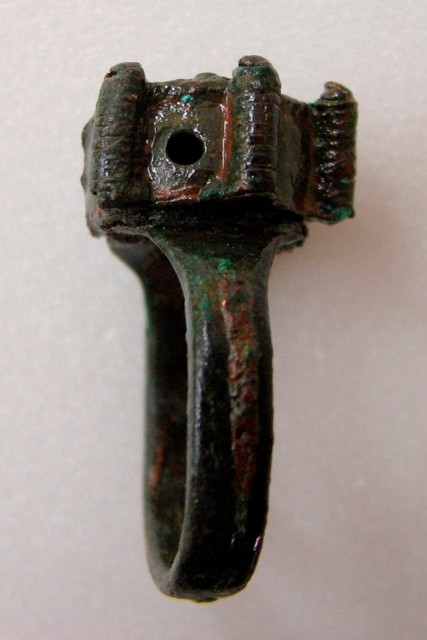
14th century Bulgarian poison ring
Text and image from The History Blog (where there are more details about relevant local history).It’s not the large cabochon gemstone that opens on a hinge to reveal a secret compartment filled with tasteless, odorless, deadly iocane* powder of your imagination. This ring has a more subtle, and therefore effective, design. It’s made out of modest bronze and has a hollow cartridge welded to the bezel. It’s finely crafted with a circular granulation detail around the top and five cylinders that look like stacked pennies going up the side. There’s a small hole on the side of the ring between two of the cylinders through which poison could be introduced into the hollow chamber and, when the propitious moment is at hand, into the food or beverage of your benighted target.
Its size suggests that it was made for a man to wear, probably on the little finger of the right hand. Since the hole is on the left side, it would be concealed by the ring finger next to it. A quick lift and tip of the pinkie and poisoning accomplished. It’s a much stealthier approach than having to open a splashy begemmed lid and turn your hand upside down without anyone noticing.
The ring was found by archaeologists excavating the remains of a 14th century fortress on Cape Kaliakra on the Black Sea about seven and a half miles from the town of Kavarna in northeast Bulgaria. Bulgaria’s National Institute of Archaeology has been excavating the fortress site since 2011. Amidst the remains of the 14th century walls, water pipes, baths and fortress, archaeologists have found more than 30 gold jewels, pearl earrings, rings set with precious and semiprecious gems. This ring is the only one made out of bronze discovered on the site.
*a fictional toxin (from The Princess Bride)
الأربعاء، 21 أغسطس 2013
Do any readers have philatelic expertise?

Or know anyone who does?
The item in the image above has me baffled. I know with 100% certainty that it's not a postage stamp, a revenue, or a cut square from postal stationery, but I don't know what it is.
The corner letters are highly reminiscent of early British postage stamps, such as the Penny Black and Penny Reds. The scrollwork in the bottom half is an elaborate "VR", which would certainly be "Victoria Regina" (Queen Victoria) - again suggesting 19th century Great Britain (or a British colony such as Australia/New Zealand). Same with the crown.
But what is it? The margins show partial frames of two adjacent items to the left and below, suggesting that it was cut and torn from a non-perforated sheet of presumably similar items. The engraving is high quality, the paper is crisp and seemingly unwatermarked. On the back is a hinge remnant, indicating that some philatelist had mounted it in an album.
It could be a simple "label" created for decorative or recreational purposes, or a "cinderella." But I think it might be a die proof which was not successful in later becoming a stamp.
I'd welcome any insights from readers.
Addendum: Andrew came up with the answer immediately. See his comment.
الثلاثاء، 20 أغسطس 2013
Ceremonial helmet of Emperor Charles V (1540)

There is no more splendid example of European dress as high political propaganda than the ceremonial armor made for the Hapsburg Holy Roman Emperors Maximilian I and Charles V and for Charles’ son, Philip II of Spain. They employed the greatest sculptural metalworkers on the continent... Such armor was rarely intended as practical protection during battle; rather it had a starring role in parades, jousting tournaments and court rituals and was favored attire for official portraits.This helmet was crafted by Desiderius Helmschmid and is now in the collections of the Patrimonio Nacional, Real Armería, Madrid. Image via Uncertain Times.
الأحد، 18 أغسطس 2013
Seabed patterned circles

Discovered here, at a depth of 80 feet off an island in the Japanese archipelago, these elaborate circles have been attributed to the work of a small puffer fish, whose activity is shown in this video:
Enhanced mating and reproductive success is one explanation, but one can't overlook the fact that this amazingly detailed circle has 27 segments - a perfect cube, and a number that is present in pi as a self-locating string (i.e. at the 27th place after the decimal), and is the number of books in the New Testament, and the number of bones in the human hand. As a famous person once said "you can't explain that."
Via the first blog I ever followed - Gerald Vlemming's The Presurfer.
الجمعة، 16 أغسطس 2013
Titanium crowns on a German Shepherd

Click image for wallpaper size. Posted by qbchottu on a German Shepherd health issues forum, via The Soul is Bone.
الجمعة، 9 أغسطس 2013
"Cat people" vampire burials

Archaeologists excavating the site of future road construction near the town of Gliwice in Silesia, southern Poland, discovered four skeletons buried with their heads between their knees. Stones were placed on the skulls. Further digging unearthed another nine skeletons buried with their heads out of place. Eleven were found with the skull between the legs, one with skull between the hands, two with the skull perched directly on the shoulders. Most of the skeletons found buried this way appear to be female.More information at The History Blog.
Putting the head anywhere but on top of the neck was a common folk practice in Slavic countries for ensuring that the dead would not rise from the grave to harry the living. The idea was that if the dead person attempted to rise, without her head in place she wouldn’t be able to see his victims or even coordinate the climb out of the grave...
There were no grave goods, not even the remains of clothing like buttons, in the initial discoveries that could give an idea of when they were buried. The ritual was in regular use in Poland from the arrival of Christianity in the 10th century until the First World War (the last known vampire burial in Poland took place in the east-central village of Old Mierzwice in 1914), so that doesn’t help narrow it down...
Osteological examination has already returned extraordinary results: the eye sockets are much larger than average while the nasomaxillary area (the part between the nose and the upper jaw) is narrower than average. This would have given them a cat-like appearance, a genetic mutation that suggests the deceased are related and that might explain why this group of people were seen as dangerous by their community.
الاشتراك في:
الرسائل (Atom)