الأحد، 21 نوفمبر 2010

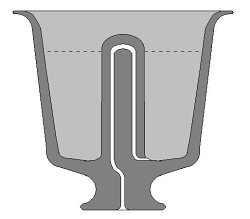
Ancient Greek "dribble glass"

"...this cup, credited to Pythagoras of Samos, works fine if you fill it no higher than the dotted line. If you add more, the liquid spills over the elbow joint and a siphon effect pours the cup’s entire contents onto your lap."
Found while rummaging in the Futility Closet.

Trying to reanimate corpses

Aldini attempted to revive the body of a murderer, one Thomas Forster, by the application of electrical charges six hours after he had been hanged at Newgate…

“On the first application of the [electrical] arcs, the jaw began to quiver, the adjoining muscles were horribly contorted, and the left eye actually opened… the conductors being applied to the ear, and to the rectum, excited muscular contractions much stronger… The arms alternately rose and fell…the fists clenched and beat violently the table on which the body lay, natural respiration was artificially established… A lighted candle placed before the mouth was several times extinguished… Vitality might have been fully restored, if many ulterior circumstances, had not rendered this – inappropriate.”

…The reports eventually caused such a public outcry that the experiments were banned, and Aldini forced to leave the country in 1805… (p. 317)
Text excerpted from The Age of Wonder: How the Romantic Generation Discovered the Beauty and Terror of Science. Richard Holmes. Pantheon Books, New York, 2008.  Additional information available online at Executed Today, where I found the illustration.

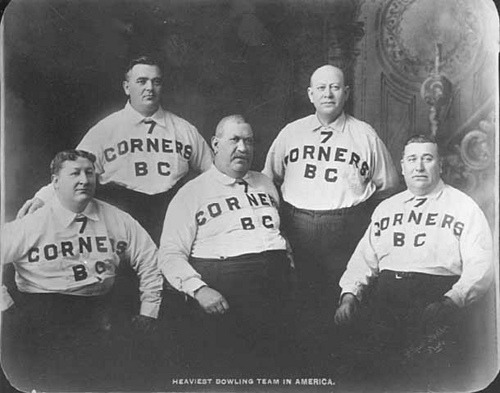
"Heaviest bowling team in America", 1911

Found at Black and WTF.

A "human orrery"

The young John Keats remembered an organized game at his school in Enfield, in which all the boys whirled round the playground in a huge choreographed dance, trying to imitate the entire solar system, including all the known moons… Unlike Newton’s perfect brassy clockwork mechanism, this schoolboy universe – complete with straying comets – was a gloriously chaotic “human orrery.”

Keats did not recall the exact details, but one may imagine seven senior boy-planets running round the central sun, while themselves being circled by smaller sprinting moons (perhaps girls), and the whole frequently disrupted by rebel comets and meteors flying across their orbits. (p. 113)
A quick search yielded evidence that this activity is still conducted today in various schools.

Text excerpted from The Age of Wonder: How the Romantic Generation Discovered the Beauty and Terror of Science. Richard Holmes. Pantheon Books, New York, 2008.
A curious orientation of the banisters

"Pender County, North Carolina. Sloop Point at Hampstead. House over 200 years old."
Found at Shorpy.

Mastectomy without anaesthesia

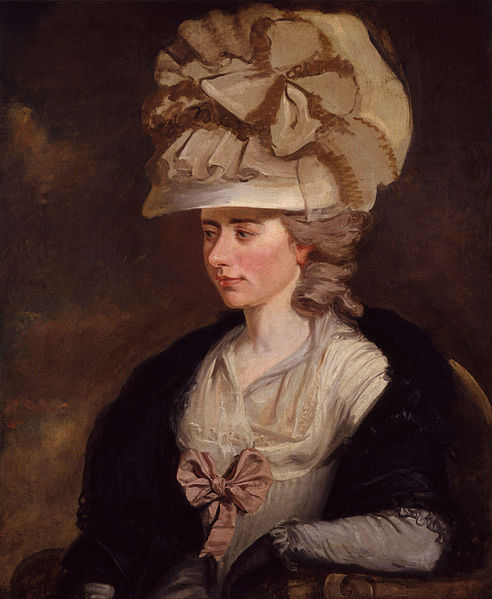
Frances Burney, an English novelist and diarist, transcribed her experience undergoing a mastectomy for breast cancer in the era before anaesthesia:
“In September 1811 the Herschels’ old friend Fanny Burney, by then the married Madame d’Arblay, underwent an agonizing operation for breast cancer without anaesthetic. It was carried out by an outstanding French military surgeon, Dominique Larrey, in Paris, and so successfully concluded that she lived for another twenty years. What is even more remarkable, Fanny Burney remained conscious throughout the entire operation, and subsequently wrote a detailed account of this experience, watching pats of the surgical procedure through the thin cambric cloth that had been placed over her face. At the time the surgeon did not realise that the material was semi-transparent. “I refused to be held; but when, bright through the cambric, I saw the glitter of polished steel – I closed my eyes. I would not trust to convulsive fear the sight of the terrible incision.”…

Indeed, she screamed throughout the operation. “When the dreadful steel was plunged into the breast – cutting through veins – arteries – flesh – nerves – I needed no injunction not to restrain my cries. I began a scream that lasted unintermittingly during the whole time of the incision - & agony… All description would be baffled… I felt the Knife rackling against the breast bone – scraping it!” (p. 305-6)
Some modern clinicians would note the twenty-year survival and suspect that her excised lesion was probably a fibroadenoma rather than a carcinoma, but that wouldn't detract from her amazing fortitude.

The text is an excerpt from The Age of Wonder: How the Romantic Generation Discovered the Beauty and Terror of Science. Richard Holmes. Pantheon Books, New York, 2008.

Collar necklace, Afghanistan, first century

"From a tomb in Tillia Tepe, Afghanistan."

Found in The Ancient World, via La Muse Verte.